A Synchronous Chip Sealing Solution is an efficient road surface treatment method that simultaneously applies bitumen binder and stone aggregates to an existing pavement. This technology creates a durable protective layer that improves waterproofing, restores surface friction, and extends pavement service life.
For highway contractors, road maintenance companies, and government infrastructure agencies, synchronous chip sealing offers a practical alternative to expensive asphalt resurfacing, particularly when the existing pavement remains structurally sound.
Unlike conventional chip sealing methods, which require separate bitumen spraying and aggregate spreading operations, an Asphalt Synchronous Chip Sealer integrates both functions into a single machine. This synchronized application improves operational efficiency, reduces equipment requirements, and helps achieve consistent aggregate coverage.
A complete solution typically includes road cleaning equipment, a synchronous chip sealing truck, a pneumatic tire roller, and equipment for removing loose aggregates.
Understanding how these machines work together helps contractors select suitable equipment, optimize construction costs, and achieve reliable pavement performance.
A successful Synchronous Chip Sealing Solution follows a coordinated construction process designed to ensure proper binder adhesion, aggregate embedment, and surface durability.
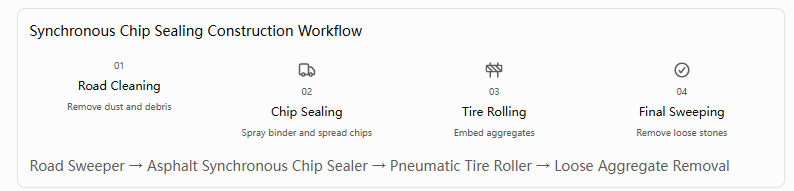
Step 1: Road Surface Cleaning
Before applying the surface treatment, the existing pavement must be thoroughly cleaned. A road sweeper removes dust, sand, loose stones, and other contaminants that could interfere with bitumen adhesion.
Proper surface preparation is especially important on highways exposed to heavy traffic, dusty environments, or prolonged dry weather.
Step 2: Simultaneous Bitumen Spraying and Aggregate Spreading
The Asphalt Synchronous Chip Sealer performs the core operation by spraying heated bitumen or a suitable bituminous binder while distributing aggregates in a synchronized process.
The machine typically includes an insulated bitumen tank, spraying system, aggregate hopper, spreading mechanism, and computerized control system.
Accurate synchronization helps reduce the time between binder application and aggregate placement, improving adhesion and reducing the risk of premature binder cooling.
Step 3: Pneumatic Tire Rolling
After aggregate placement, a pneumatic tire roller presses the stones into the binder layer.
This operation improves aggregate embedment, enhances bonding, and helps establish a uniform wearing surface. Rolling patterns and passes should follow project specifications.
Step 4: Loose Aggregate Removal
Once the binder has sufficiently set and the aggregates are stable, a sweeper removes excess loose stones.
This final operation reduces the risk of flying stones, improves driving safety, and prepares the road for normal traffic.
Engineering Insight: The effectiveness of synchronous chip sealing depends on surface preparation, correct binder application, suitable aggregate grading, proper rolling, and controlled traffic reopening—not simply the performance of the sealing truck.
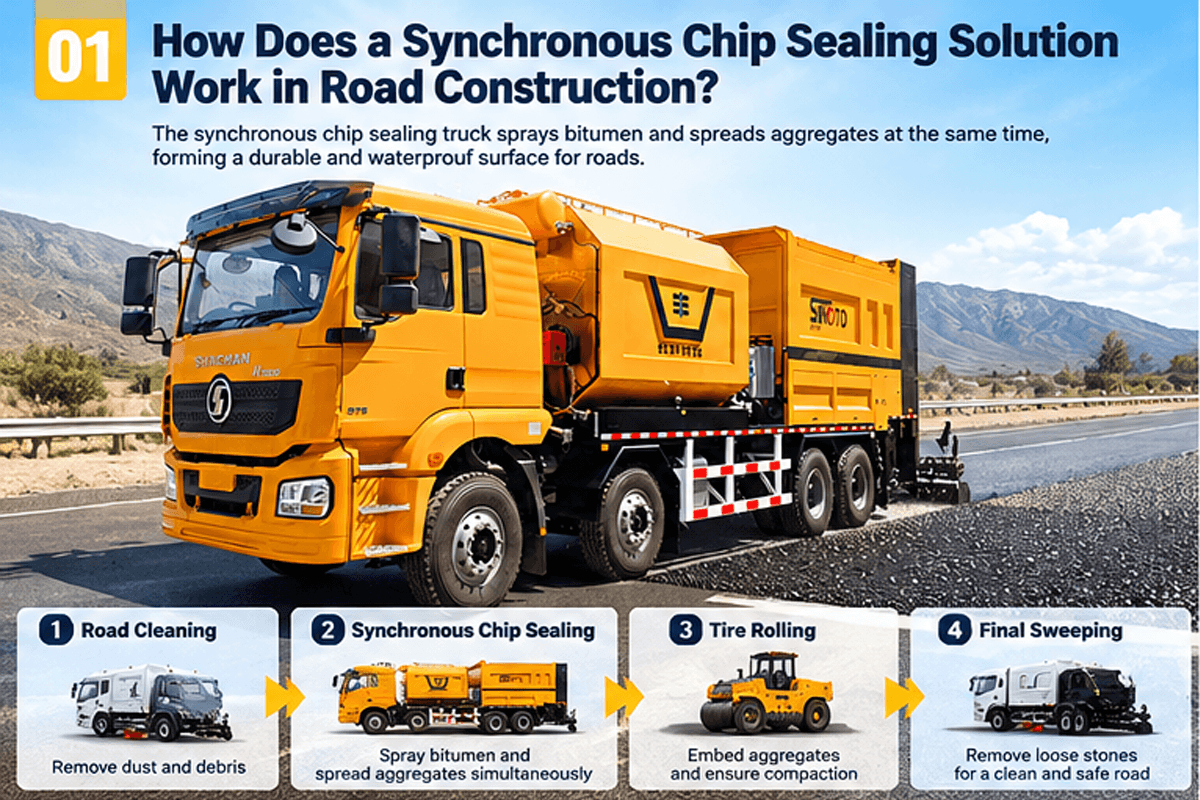
An Asphalt Synchronous Chip Sealer provides several operational and economic advantages compared with conventional road surface treatment methods.
Integrated Spraying and Spreading
One machine performs bitumen spraying and aggregate spreading, reducing the need for separate application vehicles and simplifying construction coordination.
Higher Construction Efficiency
Synchronized operations can reduce equipment repositioning, shorten the application cycle, and improve productivity on long highway maintenance projects.
Improved Waterproofing and Skid Resistance
The bitumen layer helps limit water infiltration, while properly selected aggregates provide surface texture and friction.
Precise Material Application
Advanced control systems can regulate binder spray rates and aggregate distribution according to operating speed and construction requirements.
Lower Maintenance Costs
Preventive surface treatments can help delay more expensive rehabilitation when applied to pavements in suitable condition.
|
Comparison |
Conventional Chip Sealing |
Synchronous Chip Sealing |
|---|---|---|
|
Bitumen application |
Separate distributor |
Integrated spraying system |
|
Aggregate spreading |
Separate chip spreader |
Integrated spreading system |
|
Application timing |
Sequential operations |
Synchronized operations |
|
Equipment coordination |
More complex |
Simplified |
|
Binder exposure before chips |
Potentially longer |
Usually shorter |
|
Material uniformity |
Depends on equipment and operation |
Controlled by integrated systems |
|
Project efficiency |
Depends on coordination |
Potentially higher |
For contractors handling frequent road maintenance projects, integrated chip sealing equipment can help reduce operational complexity while improving consistency.
However, final performance still depends on correct material selection, machine calibration, and experienced operation.
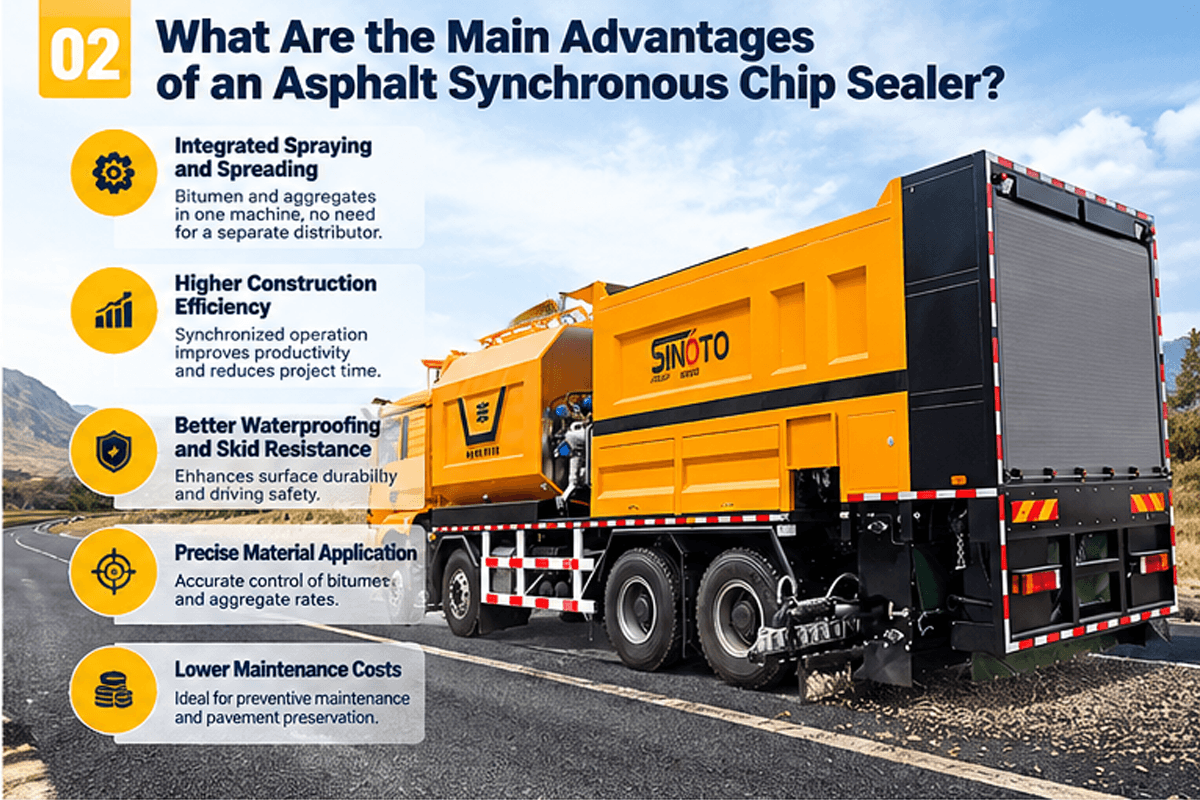
A professional Synchronous Chip Sealing Solution requires several machines working together. Each machine performs a specific task in the construction sequence.
1. Road Sweeper
Removes loose dust, sand, and debris before binder application. A mechanical sweeper or suitable suction sweeper can be selected according to pavement conditions.
2. Asphalt Synchronous Chip Sealer
The primary machine combines binder spraying and aggregate spreading. Adjustable application controls support different pavement widths, aggregate sizes, and project requirements.
3. Pneumatic Tire Roller
Uses rubber tires to press aggregates into the binder. Proper tire pressure, rolling speed, and coverage help improve stone retention.
4. Final Road Sweeper
Removes unbonded aggregates after the treatment has sufficiently cured or set, improving traffic safety and final pavement quality.
The following figures represent illustrative industry ranges rather than guaranteed specifications for a particular SINOTO model.
|
Technical Parameter |
Typical Reference Range |
|---|---|
|
Bitumen tank capacity |
4,000–12,000 L |
|
Aggregate hopper capacity |
6–16 m³ |
|
Working width |
2.5–4.5 m |
|
Bitumen application rate |
0.5–3.0 kg/m² |
|
Aggregate spreading rate |
3–25 kg/m² |
|
Operating speed |
Approximately 3–10 km/h |
|
Binder types |
Hot bitumen, modified bitumen, or compatible emulsions |
|
Control system |
Manual, automatic, or computerized |
Actual capacities, application ranges, and working speeds depend on equipment configuration, aggregate grading, binder viscosity, and project specifications.
In most standard single-layer synchronous chip sealing projects, a separate bitumen distributor is not required.
The synchronous chip sealer already combines bitumen spraying and aggregate spreading in one coordinated operation.
However, a Bitumen Distributor may still be useful for independent tack coat applications, prime coats, or specialized multi-stage pavement treatments.
This distinction is important for buyers seeking to avoid unnecessary equipment purchases.
A Synchronous Chip Sealing Solution is widely applied in preventive pavement maintenance and surface protection projects.
Its suitability depends on existing pavement condition, traffic demand, climate, aggregate characteristics, and binder selection.
Chip sealing protects asphalt pavement against moisture penetration, oxidation, and progressive surface deterioration.
It is particularly suitable for roads showing early signs of aging but without major structural failures.
For regional roads with limited maintenance budgets, chip sealing provides a cost-effective surface preservation option.
The treatment can improve surface texture and extend pavement life without requiring a full asphalt overlay.
A properly constructed chip seal helps reduce water infiltration into the pavement structure.
This is valuable in regions exposed to seasonal rainfall, freeze-thaw cycles, or surface moisture damage.
Chip sealing may be considered for suitable low-speed industrial roads, access roads, and selected service areas.
For airport pavements, aggregate retention and foreign object debris risks require special evaluation; chip seals should not be assumed suitable for runways or other aircraft operating surfaces.
|
Road Condition |
Suitability |
Recommendation |
|---|---|---|
|
Sound pavement with minor aging |
High |
Preventive chip sealing |
|
Minor surface cracking |
Conditional |
Repair cracks and assess sealing |
|
Reduced surface friction |
High |
Select suitable aggregate texture |
|
Minor surface oxidation |
High |
Surface protection treatment |
|
Severe rutting or potholes |
Low |
Structural or localized repairs first |
|
Weak pavement foundation |
Low |
Structural rehabilitation required |
Project Recommendation: Chip sealing is a surface preservation treatment, not a structural repair method. Existing potholes, severe deformation, and unstable pavement layers should be repaired before application.
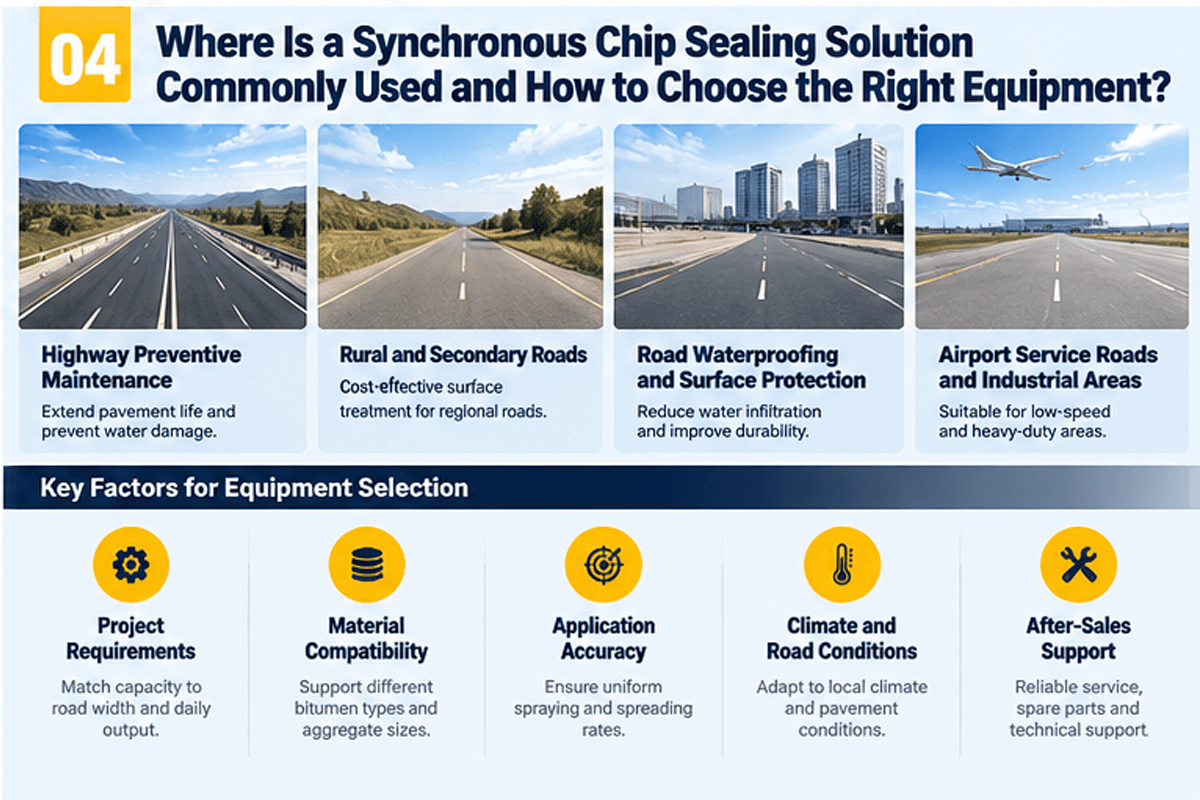
Selecting the correct Synchronous Chip Sealing Solution requires evaluating project scale, road conditions, material specifications, equipment configuration, and long-term operating costs.
For international contractors and equipment distributors, the following factors deserve particular attention.
1. Match Equipment Capacity to Project Requirements
Highway projects covering large daily areas may require machines with larger binder tanks, higher aggregate capacity, and wider application systems.
Smaller municipal projects may benefit from compact equipment with better maneuverability.
2. Evaluate Binder and Aggregate Compatibility
Buyers should confirm whether the machine supports the specified bitumen grades, polymer-modified binders, or compatible emulsified binders.
Aggregate spreading systems should accommodate the required chip sizes and application rates.
3. Check Spraying and Spreading Accuracy
Consistent binder coverage and uniform aggregate distribution are critical to preventing bleeding, streaking, and premature stone loss.
Ask suppliers about spray bar design, nozzle controls, spreading accuracy, calibration procedures, and speed-linked control systems.
4. Consider Local Climate and Road Conditions
Hot climates require careful binder selection to reduce bleeding, while colder conditions demand appropriate application temperatures and weather windows.
For projects in the Middle East, Africa, and Southeast Asia, dust management, ambient temperature, and aggregate availability may influence equipment selection.
5. Evaluate Maintenance and After-Sales Support
Reliable equipment should provide accessible maintenance points, durable hydraulic components, clear operating instructions, and dependable spare parts support.
Buyers should also request information about operator training, technical assistance, warranty coverage, and replacement part availability.
|
Buyer Concern |
Questions to Ask the Supplier |
|---|---|
|
Productivity |
What is the effective working width and daily output? |
|
Material compatibility |
Which binders and aggregate sizes are supported? |
|
Application accuracy |
How are spray and spreading rates controlled? |
|
Operating costs |
What are the fuel and maintenance requirements? |
|
Transportation |
What are the machine dimensions and operating weight? |
|
Reliability |
Which hydraulic and control components are installed? |
|
After-sales service |
Are spare parts, training, and technical support available? |
|
Customization |
Can the machine meet local road and climate conditions? |
Before placing an order, contractors should provide the supplier with the target road width, project area, binder specification, aggregate grading, and expected daily productivity.
These details help ensure that the selected equipment matches actual construction requirements.
A well-designed Synchronous Chip Sealing Solution combines efficient equipment coordination with reliable pavement preservation technology.
By integrating bitumen spraying and aggregate spreading into one machine, contractors can simplify construction, reduce unnecessary equipment duplication, and improve material application consistency.
When combined with proper road cleaning, pneumatic tire rolling, and final sweeping, synchronous chip sealing can deliver a durable, waterproof, and skid-resistant pavement surface.
For road construction companies, highway maintenance contractors, and infrastructure project developers, selecting the right equipment is essential to achieving long-term project value.
SINOTO provides road construction machinery solutions designed to support different project scales and operating environments.
Are you planning a highway maintenance project or looking for a reliable Asphalt Synchronous Chip Sealer?
Contact SINOTO to discuss your road conditions, required working width, binder specifications, equipment configuration, and project budget.
Our team can help you evaluate suitable equipment options and prepare a project-specific quotation.
Get Equipment Specifications & a Quotation
Tell us your project location, road area, binder type, and target productivity to receive a tailored equipment recommendation.
Request a Free Quote The link opens the product page, where you can continue with an equipment inquiry.Hashtags:
#SynchronousChipSealing #AsphaltChipSealer #RoadMaintenanceEquipment #ChipSealTechnology #RoadConstructionMachinery #SINOTO

Whatsapp ID: 8619059581045

WeChat ID: +8619059581045

