When buyers evaluate an Emulsion Bitumen Plant, one of the first questions is usually simple: How many tons per hour can the plant produce, and is the production process continuous or batch-based?
For road contractors, asphalt producers, pavement maintenance companies, and infrastructure developers, production capacity directly affects project scheduling, operating costs, storage requirements, and return on investment. Choosing an asphalt emulsion plant therefore requires more than looking at a single TPH number. Buyers should also consider the plant configuration, colloid mill capacity, pumping system, automation level, emulsion formulation, and expected daily production.
The SINOTO bitumen emulsion plant range is designed for different production requirements, with standard models covering approximately 3–15 TPH, while the product page indicates an overall productive-capacity range of 3–20 TPH and customized continuous production solutions for larger infrastructure projects.
| Model | Rated Production Capacity | Colloid Mill Power | Typical Application |
|---|---|---|---|
| STEB-4 | 3–4 TPH | 11 kW | Small and medium projects |
| STEB-6 | 5–6 TPH | 22 kW | Regional road maintenance |
| STEB-10 | 8–10 TPH | 37 kW | Commercial asphalt emulsion production |
| STEB-15 | 12–15 TPH | 45 kW | Large road and highway projects |
| Customized | Up to project requirement | Project-specific | Large-scale infrastructure |
The published technical parameters show different production capacities for the standard models. The page also states that customized continuous production lines can be supplied for large-scale infrastructure projects.
💡 Buyer Insight: If your target output is around 6 TPH, the STEB-6 is the corresponding standard capacity class. If your requirement is around 10 TPH, the STEB-10 provides an 8–10 TPH production range. For higher-volume projects, the STEB-15 or a customized production line can be considered.
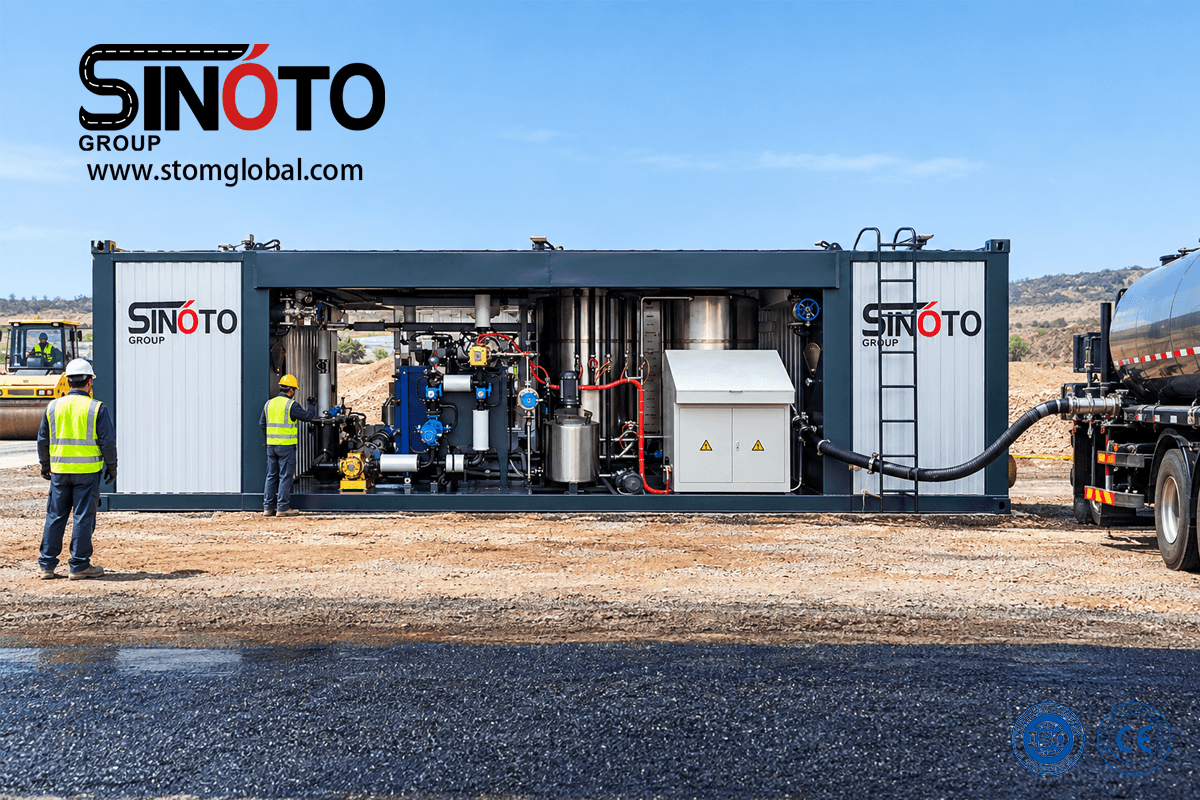
A common buyer concern is whether a bitumen emulsion plant operates like a conventional batch mixer or whether it can continuously produce asphalt emulsion.
The answer depends on the plant configuration and control system. SINOTO’s equipment is designed around continuous material flow through the bitumen, water, emulsifier, metering, colloid milling, pumping, and cooling stages. The system uses two emulsion tanks alternately, allowing one tank to receive or process material while the other supports the next stage of operation.
This configuration is important because asphalt emulsion production requires accurate control of several materials rather than simply mixing hot bitumen and water.
The main process can be summarized as:
Bitumen Heating → Water & Soap Preparation → Accurate Metering → High-Shear Emulsification → Cooling → Emulsion Pumping → Storage
1. Bitumen Heating
Bitumen is heated to the required processing temperature before entering the emulsification system.
2. Soap Solution Preparation
Water and emulsifier are prepared according to the required formulation.
3. Precise Metering
Bitumen, water, and soap solution are proportioned according to the required formulation.
4. High-Shear Emulsification
The colloid mill applies high-speed mechanical shearing to disperse bitumen into very small droplets.
5. Cooling & Stabilization
The emulsion is cooled efficiently before being pumped to storage or downstream equipment.
6. Continuous Transfer
The emulsion pumping and alternating tank arrangement support continuous production when the plant is configured for continuous operation.
The colloid mill is one of the most important components in an asphalt emulsion plant because it directly influences particle dispersion and emulsion quality.
The SINOTO system uses an adjustable high-precision colloid mill. The product information specifies that the rotor-stator clearance can be adjusted to as low as 0.01 mm, helping achieve uniform particle size and stable asphalt emulsion production.
For buyers, this means the rated TPH figure should not be considered separately from the emulsification system. A high-output bitumen emulsion plant for sale needs an appropriately sized colloid mill, pumps, tanks, heating system, cooling system, and control system to maintain consistent production.
📌 Technical Point: Production capacity is not simply the capacity of the colloid mill. It is the result of the complete production line working together—including material metering, emulsification, pumping, heating, cooling, and control.
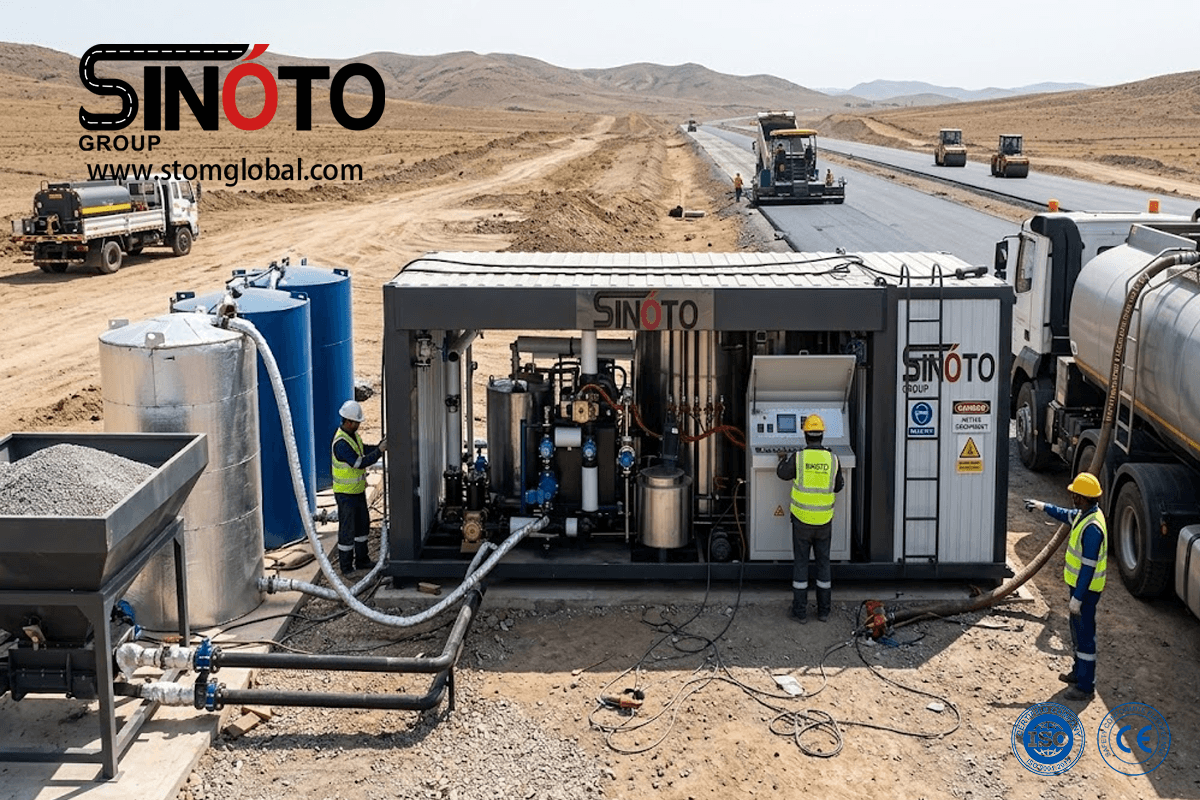
Choosing between a 6 tph asphalt emulsion plant, a 10 TPH-class machine, or a larger production system depends primarily on project demand.
A smaller plant can be suitable when production requirements are moderate or when the buyer wants to supply a regional market. A larger plant becomes more relevant when the customer operates multiple road projects simultaneously or supplies emulsion to several construction teams.
| Required Output | Recommended Capacity Class | Buyer Profile |
|---|---|---|
| 3–4 TPH | STEB-4 | Small contractors / local projects |
| 5–6 TPH | STEB-6 | Medium contractors / regional supply |
| 8–10 TPH | STEB-10 | Commercial production / larger projects |
| 12–15 TPH | STEB-15 | Highway contractors / large infrastructure |
| 15+ TPH | Customized | Large-scale industrial production |
If a buyer searches for a 10 tph bitumen emulsion plant, it is important to understand that the STEB-10 is specified at 8–10 TPH, rather than being a fixed 10 TPH output under every operating condition.
Likewise, a buyer searching for a 6 tph asphalt emulsion plant should understand that the STEB-6 is specified at 5–6 TPH.
This distinction matters when preparing a business plan or calculating the amount of emulsion that can be produced per working day.
Before asking for an asphalt emulsion plant price, buyers should estimate:
Required production per hour
Required production per day
Number of working hours per day
Required emulsion grades
Bitumen solid content
Storage tank capacity
Available electricity supply
Heating requirements
Required automation level
Local road construction demand
For example, a contractor requiring approximately 60 tons of emulsion per working day may not necessarily need a 15 TPH system. Depending on working hours, a 6–10 TPH plant may provide an appropriate production range.
On the other hand, if a producer needs to supply multiple highway projects at the same time, a higher-capacity asphalt emulsion plant or customized continuous line can reduce production bottlenecks.
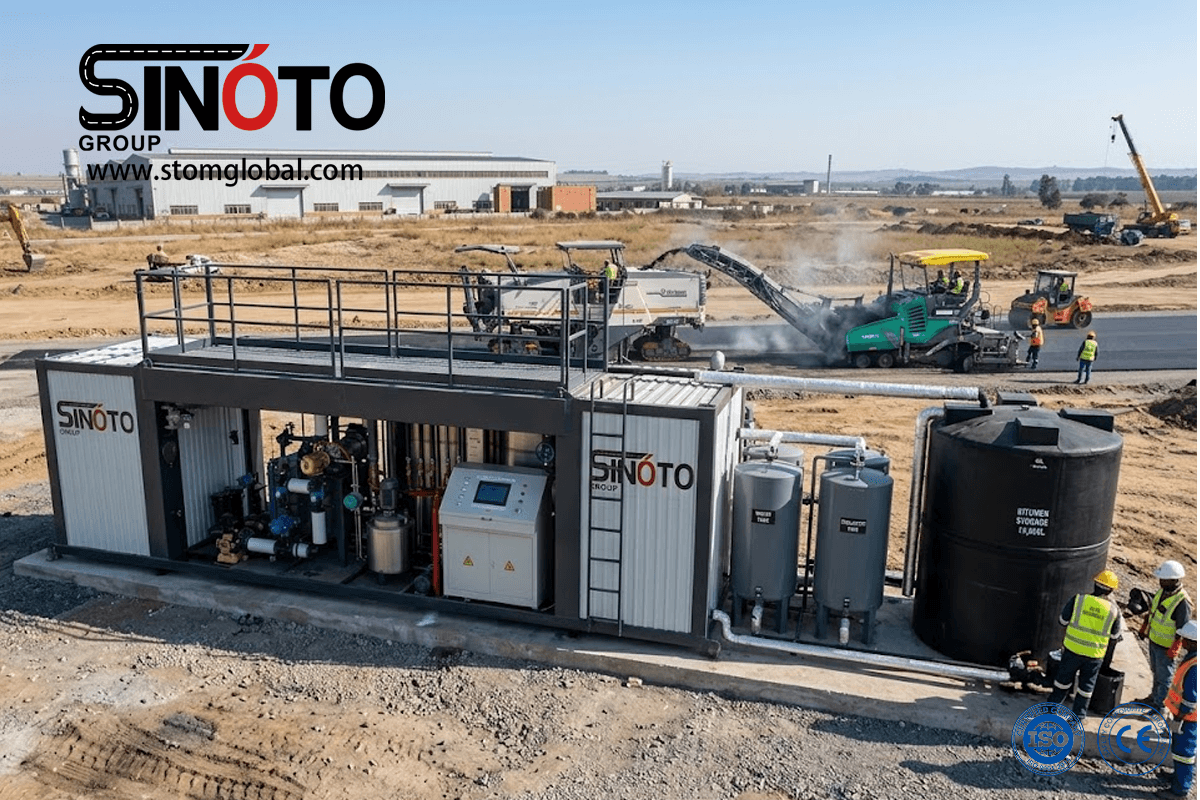
Production capacity is only one part of the purchasing decision. When comparing an emulsion plant manufacturer, buyers should also evaluate the core equipment, material compatibility, automation, maintenance requirements, and installation design.
The SINOTO system can use Siemens PLC technology for automated proportioning of asphalt, emulsifier, and water. The published product information states that automatic compensation can control proportioning errors within approximately 0.5%.
For commercial asphalt emulsion production, accurate proportioning is important because changes in the bitumen-to-soap ratio can affect viscosity, stability, and final product performance.
For buyers who want reduced operator intervention, an automatic control configuration can also improve repeatability between production cycles.
A high-quality colloid mill is central to the production process.
The rotor and stator perform high-speed shearing, breaking the bitumen into fine droplets and dispersing them throughout the aqueous phase.
For a bitumen emulsion plant price comparison, buyers should therefore ask:
What is the colloid mill power?
What material is used for the rotor and stator?
Is the gap adjustable?
How easy is maintenance?
What emulsion grades can the system produce?
These questions provide more useful information than comparing equipment prices alone.
A major advantage of a flexible cationic emulsion plant or multi-purpose asphalt emulsion system is its ability to accommodate different formulations.
The SINOTO product page lists compatibility with multiple emulsion types, including RS, CRS, MS, CMS, SS, CSS, and CQS grades. The equipment is also described as suitable for anionic, cationic, fast-setting, medium-setting, slow-setting, and modified emulsion production.
This flexibility can be particularly valuable for suppliers serving different customers or road projects.
Emulsifiers and additives can create demanding operating conditions for equipment components.
The published design uses corrosion-resistant 316 stainless steel or PPR for relevant emulsifier dilution, blending, and conveying systems.
For buyers comparing an asphalt emulsion plant manufacturer, material selection should therefore be included in the technical evaluation.
International buyers often have another concern: transportation and installation.
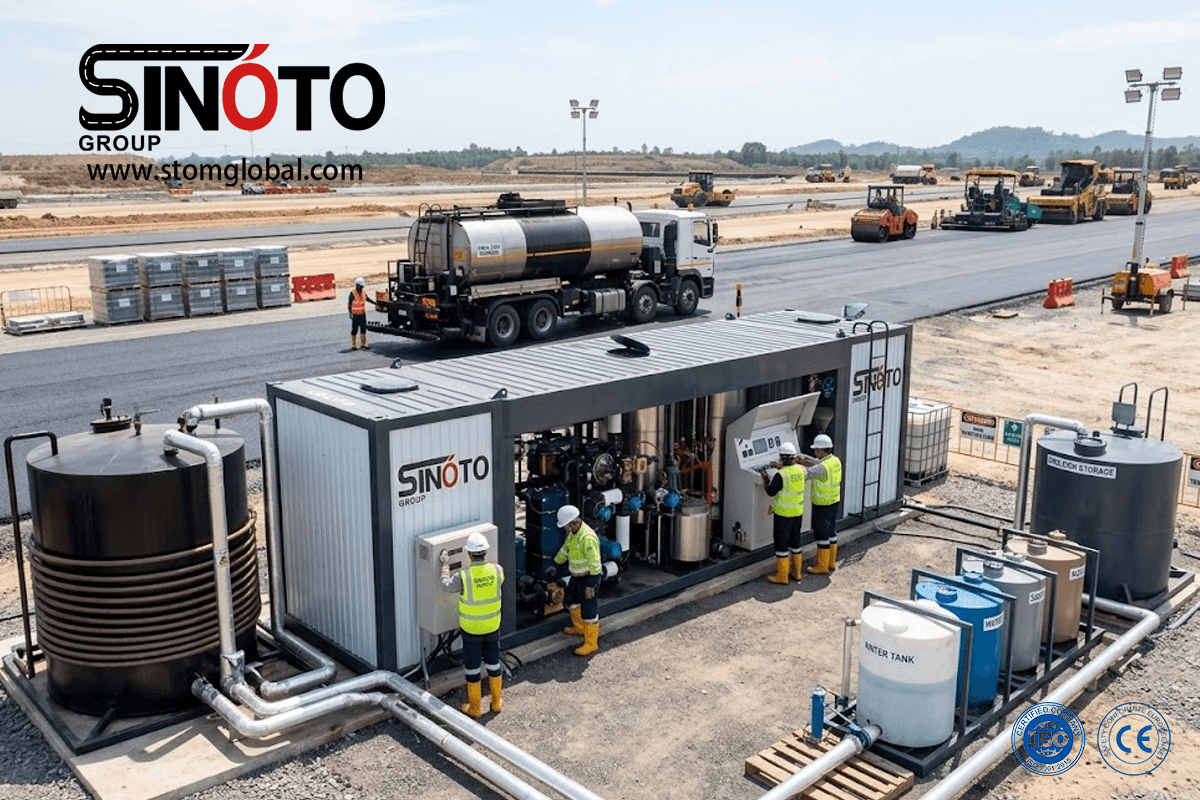
The SINOTO bitumen emulsion plant uses an integrated, modular design intended for container transportation. The product page indicates that the skid-mounted configuration can fit into standard 40-foot high-cube containers.
This can simplify overseas transportation, installation, and relocation.
🌍 International Buyer Tip: For an overseas bitumen emulsion plant for sale, ask the manufacturer to provide a complete shipping list, container loading plan, installation requirements, electrical specifications, foundation requirements, spare-parts list, and commissioning instructions before placing the order.
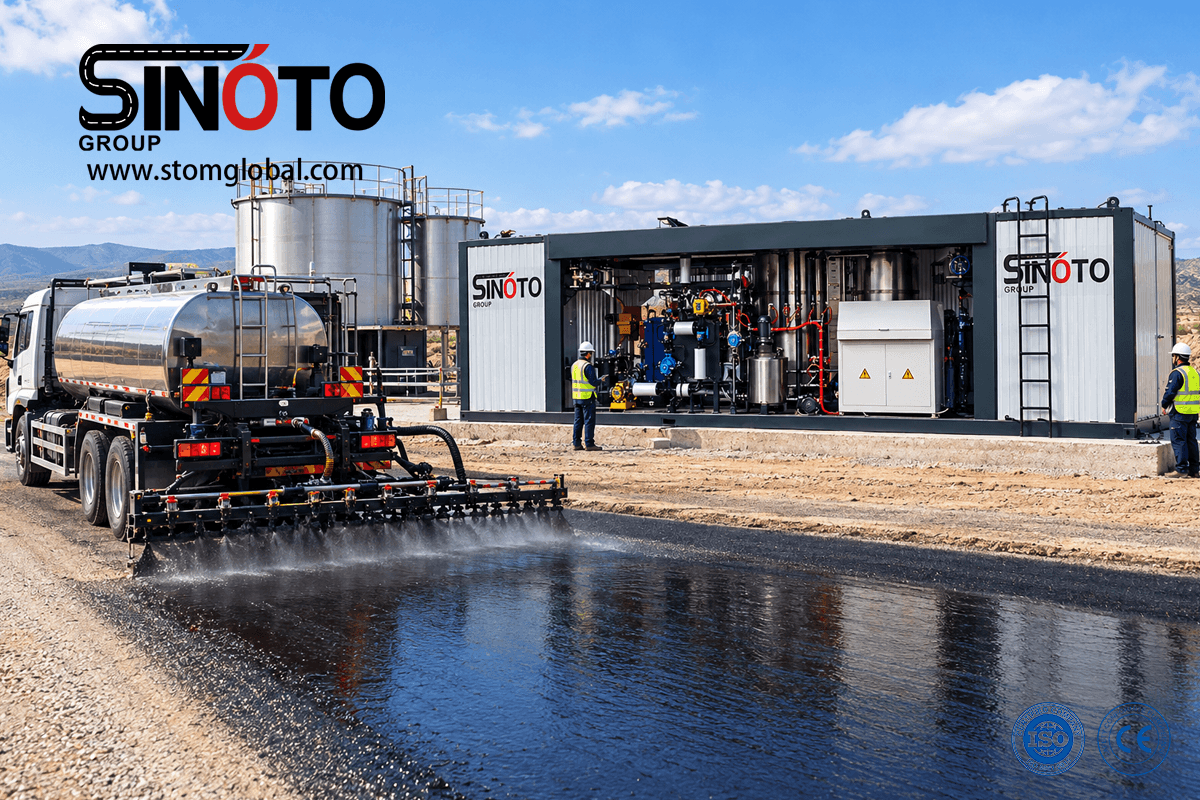
A buyer looking for an asphalt emulsion plant for sale should not make a purchasing decision based only on the advertised TPH.
The following checklist can help buyers compare suppliers more systematically.
Ask for the actual rated capacity of the proposed model.
For example:
STEB-4: 3–4 TPH
STEB-6: 5–6 TPH
STEB-10: 8–10 TPH
STEB-15: 12–15 TPH
If your project requires exactly 10 TPH or more than 15 TPH, ask whether the manufacturer recommends a larger or customized configuration.
Ask specifically:
“Is this configuration designed for continuous production?”
This is important because the terms “automatic” and “continuous” do not mean exactly the same thing.
Automation refers to how the control system manages the process. Continuous production refers to the ability of the production system to maintain material flow without requiring a complete stop between individual production batches.
The SINOTO product information describes alternating emulsion tanks and customized continuous production lines, supporting continuous operation when appropriately configured.
Ask which formulations the proposed plant can produce.
For example, determine whether your project requires:
Cationic emulsion
Anionic emulsion
Rapid-setting emulsion
Medium-setting emulsion
Slow-setting emulsion
Modified asphalt emulsion
This is particularly important for contractors involved in chip sealing, tack coating, prime coating, slurry sealing, micro-surfacing, and other pavement preservation applications.
The asphalt emulsion plant price depends on more than production capacity.
A quotation may vary according to:
Plant capacity
Automation level
Colloid mill power
Tank configuration
Heating system
Cooling system
Pump specifications
Material grade
Control cabinet
Customized formulation requirements
Spare parts
Shipping configuration
Therefore, buyers should provide their target capacity, product type, country, voltage, and application when requesting a quotation.
When comparing bitumen emulsion plant price or asphalt emulsion plant price, the lowest initial quotation does not necessarily represent the lowest overall investment.
A complete comparison should consider:
Purchase Cost + Installation Cost + Energy Consumption + Maintenance + Spare Parts + Labor + Production Efficiency
For a commercial producer, a more automated plant may require a higher initial investment but reduce manual operation and improve production consistency.
For a smaller contractor, a lower-capacity system may be more appropriate if the expected demand does not justify a larger plant.
 What Is the Final Answer on TPH and Continuous Production?
The short answer is:
The SINOTO Emulsion Bitumen Plant product range covers approximately 3–20 TPH, with standard models including 3–4 TPH, 5–6 TPH, 8–10 TPH, and 12–15 TPH. The plant is not limited to simple batch production; its alternating emulsion tanks and automated configuration support continuous production, while customized continuous lines are available for larger infrastructure projects.
For buyers specifically searching for a 10 tph bitumen emulsion plant, the STEB-10 is rated at 8–10 TPH.
For buyers searching for a 6 tph asphalt emulsion plant, the STEB-6 is rated at 5–6 TPH.
The best configuration should ultimately be selected according to required output, emulsion formulation, working hours, automation requirements, and project scale.
Need 3–4 TPH?
→ Consider STEB-4
Need around 6 TPH?
→ Consider STEB-6
Need around 10 TPH?
→ Consider STEB-10
Need 12–15 TPH?
→ Consider STEB-15
Need higher or customized output?
→ Request a customized continuous production solution
The key is to match the plant capacity with your actual production demand rather than selecting equipment solely by the largest advertised number.
If you are comparing bitumen emulsion plant for sale options and need help selecting the right capacity, SINOTO can evaluate your required TPH, emulsion type, automation level, and project application.
Provide your target capacity—such as 6 TPH, 10 TPH, or 15 TPH—along with your required emulsion type and destination country. The manufacturer can then recommend a suitable configuration and prepare a project-specific quotation.
👉 Request a Quote for Your Emulsion Bitumen Plant

Whatsapp ID: 8619059581045

WeChat ID: +8619059581045

