When buyers search for a bitumen emulsion plant for sale, one important question often determines whether the equipment is suitable for advanced road construction applications: Does the plant include a system for heating and adding polymer latex, such as SBS or SBR, for modified emulsion production?
This question matters because polymer-modified asphalt emulsion is used in demanding pavement applications where contractors may require improved binder performance, flexibility, durability, or resistance to traffic-related stresses. A standard asphalt emulsion plant may be suitable for conventional emulsified asphalt, but a modified emulsion production line may require additional equipment, formulation control, and process engineering.
According to the SINOTO Emulsion Bitumen Plant product information, the equipment is designed to produce different types of emulsified bitumen and can be configured for SBS and SBR modified bitumen emulsion production. The manufacturer specifically describes heavy-duty colloid mills and enhanced soap systems for modified emulsion applications.
However, there is an important distinction for buyers: the published product page does not explicitly confirm that every standard plant includes a separate polymer latex heating tank, latex storage tank, dedicated latex dosing pump, or automatic SBS/SBR latex addition system.
Therefore, the most accurate answer is:
Yes, the SINOTO plant is designed to support SBS and SBR modified bitumen emulsion production. Whether a dedicated polymer latex heating and metering system is included depends on the required formulation and project-specific equipment configuration.
This distinction is essential when comparing an asphalt emulsion plant for sale, especially when the buyer needs high-polymer-content emulsions or specialized pavement treatment products.
💡 Quick Answer: SINOTO supports SBS and SBR modified bitumen emulsion production with heavy-duty colloid mills and enhanced soap systems. The standard product page does not explicitly confirm a separate polymer latex heating and dosing module. Buyers should request a customized technical proposal specifying polymer type, latex content, heating requirements, dosing method, and automatic control.
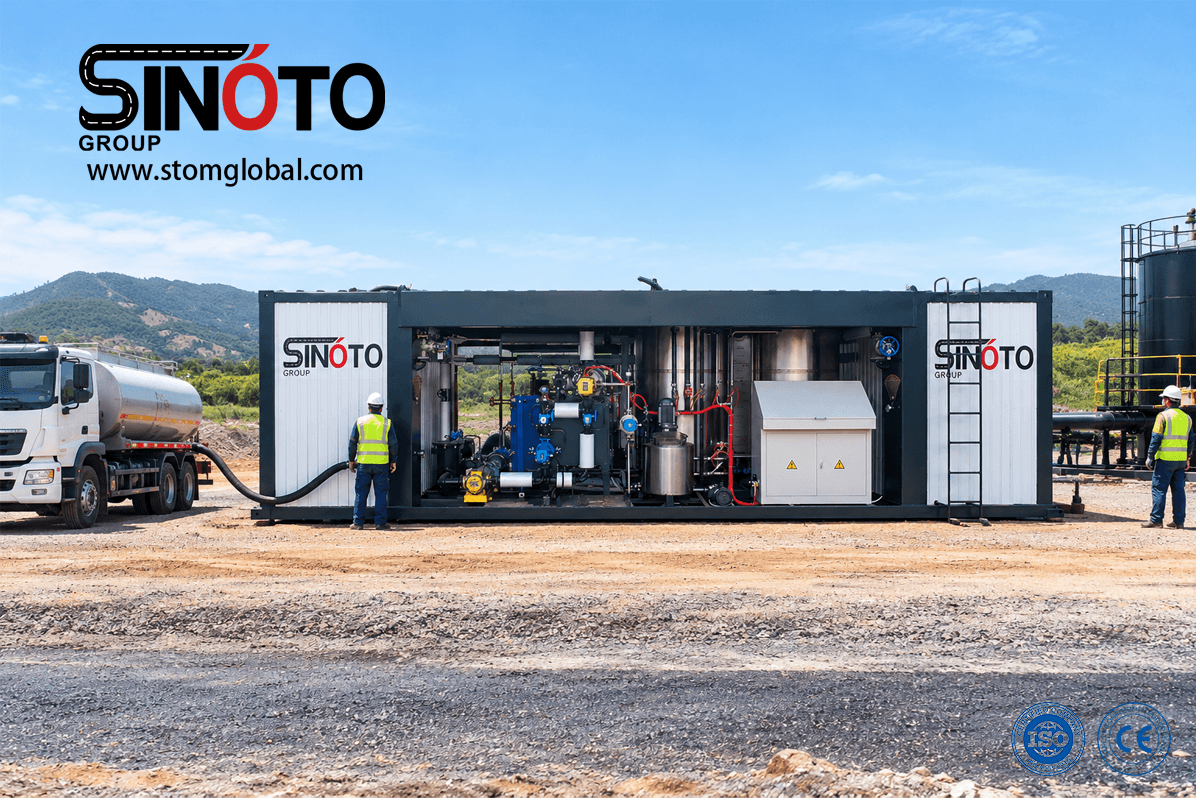
A modern bitumen emulsion plant uses water, bitumen, emulsifier, and mechanical shearing to produce an oil-in-water asphalt emulsion. When polymer modification is required, the production process may also involve polymer materials or latex systems designed to modify the properties of the asphalt binder.
The exact equipment depends on the selected polymer technology.
For example, SBS and SBR are two commonly used polymer systems in modified asphalt applications. They are not necessarily handled in the same way, and a plant designed for one polymer formulation may require different equipment for another.
| Equipment / System | Purpose | Buyer Requirement |
|---|---|---|
| Bitumen heating system | Maintains suitable bitumen temperature | Confirm operating temperature |
| Soap preparation system | Prepares aqueous emulsifier solution | Confirm formulation compatibility |
| High-shear colloid mill | Disperses bitumen into fine droplets | Confirm mill type and power |
| Polymer latex storage | Holds polymer latex when required | Confirm tank size and material |
| Polymer heating system | Maintains suitable latex temperature when required | Confirm whether heating is needed |
| Polymer dosing pump | Adds polymer according to formulation | Confirm pump type and accuracy |
| Automatic control | Coordinates material addition | Confirm PLC and dosing functions |
| Emulsion cooling system | Controls finished emulsion temperature | Confirm heat exchanger and cooling capacity |
| Storage tanks | Holds finished modified emulsion | Confirm capacity and agitation needs |
The SINOTO product page confirms the presence of an asphalt heating system, soap tank, emulsion pumping system, emulsion metering system, colloid mill, cooling system, and control system. It also states that the plant can be configured for SBS and SBR modified bitumen emulsion production.
However, a separate polymer latex heating and dosing module is not explicitly listed in the standard technical parameter table.
This is why a buyer should not assume that every bitumen emulsion machine for sale includes a complete polymer latex processing system.
Polymer-modified emulsions may require different processing conditions from conventional emulsified asphalt.
Depending on the polymer system, the production line may need:
Controlled polymer storage
Appropriate mixing or agitation
Accurate polymer dosing
Temperature management
Compatibility between polymer and emulsifier
High-shear dispersion
Controlled formulation sequence
Cleaning and changeover procedures
For a commercial asphalt emulsion plant manufacturer, these details can affect the design of the entire production line.
For a buyer, the key question is not simply whether the manufacturer can produce modified emulsion. The buyer should ask whether the proposed plant includes all equipment necessary for the specific polymer formulation.
📌 Buyer Insight: “SBS/SBR compatible” and “complete automatic polymer latex dosing system included” are two different specifications. Always request a component list and process flow diagram before confirming the purchase.
Yes. SINOTO’s product information specifically states that the plant can be configured for SBS and SBR modified bitumen emulsion production, using heavy-duty mills and enhanced soap systems.
This is an important selling point for buyers who need a flexible bitumen emulsion equipment solution.
However, the production process depends on the type of polymer used.
SBS stands for Styrene-Butadiene-Styrene.
It is a block copolymer used in modified asphalt systems to improve selected binder properties.
SBS modification can be relevant for applications where the buyer requires improved performance characteristics under traffic, temperature changes, or demanding pavement conditions.
For a plant producing SBS-modified asphalt emulsion, the exact process may depend on whether the polymer is introduced as a latex, polymer solution, or another compatible material form.
The plant configuration must therefore be selected according to the actual SBS product being used.
SBR stands for Styrene-Butadiene Rubber.
SBR is commonly used in modified asphalt systems where improved flexibility and selected binder performance characteristics are required.
For SBR-modified emulsion production, the manufacturer needs to confirm:
SBR type
Latex concentration
Polymer solids content
Required polymer dosage
Base bitumen grade
Emulsifier type
Target emulsion grade
Required production capacity
Storage stability requirements
The exact SBR handling system depends on the formulation.
| Item | SBS Modified Emulsion | SBR Modified Emulsion |
|---|---|---|
| Polymer | Styrene-Butadiene-Styrene | Styrene-Butadiene Rubber |
| Possible form | Depends on supplier formulation | Often supplied as latex or other compatible form |
| Main consideration | Compatibility and dispersion | Latex handling and formulation control |
| Heating requirement | Formulation dependent | Formulation dependent |
| Dosing system | Confirm required equipment | Confirm required equipment |
| Colloid mill | Heavy-duty configuration may be required | Heavy-duty configuration may be required |
| Plant configuration | Project-specific | Project-specific |
The important point is that SBS and SBR should not automatically be treated as identical raw materials.
A buyer searching for a bitumen emulsion machine manufacturer should specify the exact polymer material and its technical data sheet.
A road contractor may purchase modified emulsion for:
Micro-surfacing
Pavement preservation
Chip sealing
Surface dressing
High-performance road surfacing
Specialized maintenance applications
Each application can require different performance characteristics.
For example, micro-surfacing may require a specific modified emulsion formulation and compatibility with aggregate, while chip sealing may require a different breaking behavior.
The correct plant configuration must therefore be matched to the intended road application.
🔬 Technical Note: The plant’s ability to support SBS/SBR modification does not automatically guarantee that every polymer grade, polymer content, or emulsion specification can be produced. The final formulation must be validated with the selected raw materials and equipment configuration.
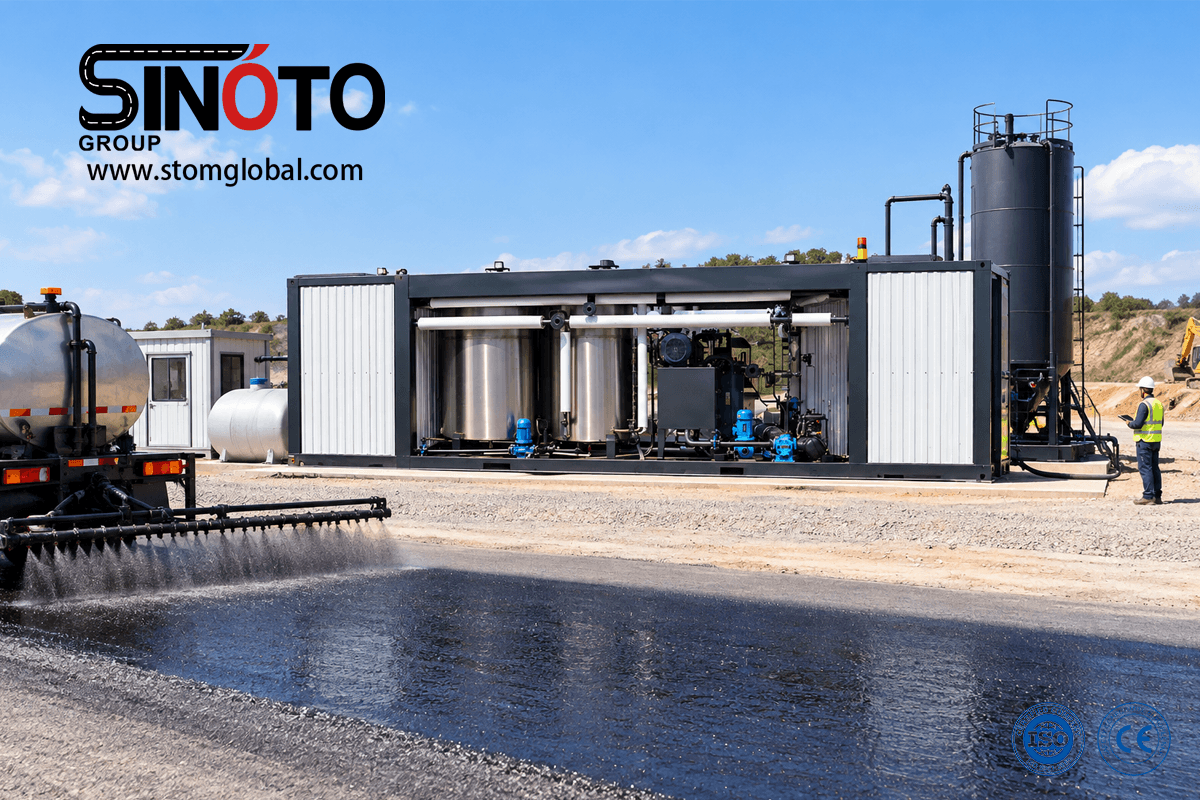
This is the most direct purchasing question.
The published SINOTO product page confirms that the plant includes heating, soap preparation, emulsification, pumping, cooling, and control systems. It also confirms that SBS and SBR modified emulsion production can be supported.
However, the page does not explicitly list a separate polymer latex heating tank or polymer latex dosing pump in the standard model specifications.
Therefore, buyers should distinguish between three possible equipment configurations.
A standard plant may include:
Bitumen heating system
Water heating tank
Soap tanks
Emulsion pump
Bitumen pump
High-shear colloid mill
Emulsion cooling system
Control system
This configuration is suitable for conventional emulsified asphalt production, subject to the selected formulation.
A modified-emulsion configuration may include:
Heavy-duty colloid mill
Enhanced soap system
Additional formulation control
Polymer-compatible material handling
Modified emulsion production parameters
SINOTO specifically describes this type of configuration for SBS and SBR modified bitumen emulsion production.
For a project that requires polymer latex heating and automatic addition, the buyer may need to specify:
Polymer latex storage tank
Polymer latex heating system, if required
Polymer latex agitation
Dedicated latex dosing pump
Flow meter or weighing system
Automatic dosing control
Polymer-compatible pipelines
Cleaning system
Temperature monitoring
Integration with PLC
Whether these components are included should be confirmed in the quotation.
| Feature | Published SINOTO Information |
|---|---|
| SBS modified emulsion production | Supported with appropriate configuration |
| SBR modified emulsion production | Supported with appropriate configuration |
| Heavy-duty colloid mill | Confirmed for modified production |
| Enhanced soap system | Confirmed for modified production |
| Bitumen heating system | Included |
| Water heating system | Included |
| Soap preparation tanks | Included |
| Emulsion cooling system | Included |
| Dedicated polymer latex heating tank | Not explicitly listed |
| Dedicated polymer latex dosing pump | Not explicitly listed |
| Automatic latex dosing logic | Requires project confirmation |
| Exact polymer dosage range | Requires formulation confirmation |
This table is important because it separates published specifications from project-dependent engineering.
For buyers searching for an asphalt emulsion plant price, this distinction can prevent misunderstandings about what is included in the standard quotation.
⚠️ Important Buyer Warning: Do not assume that “SBS/SBR modified emulsion production” means the standard machine automatically includes every polymer latex storage, heating, dosing, and control component. Request the complete equipment scope in writing.
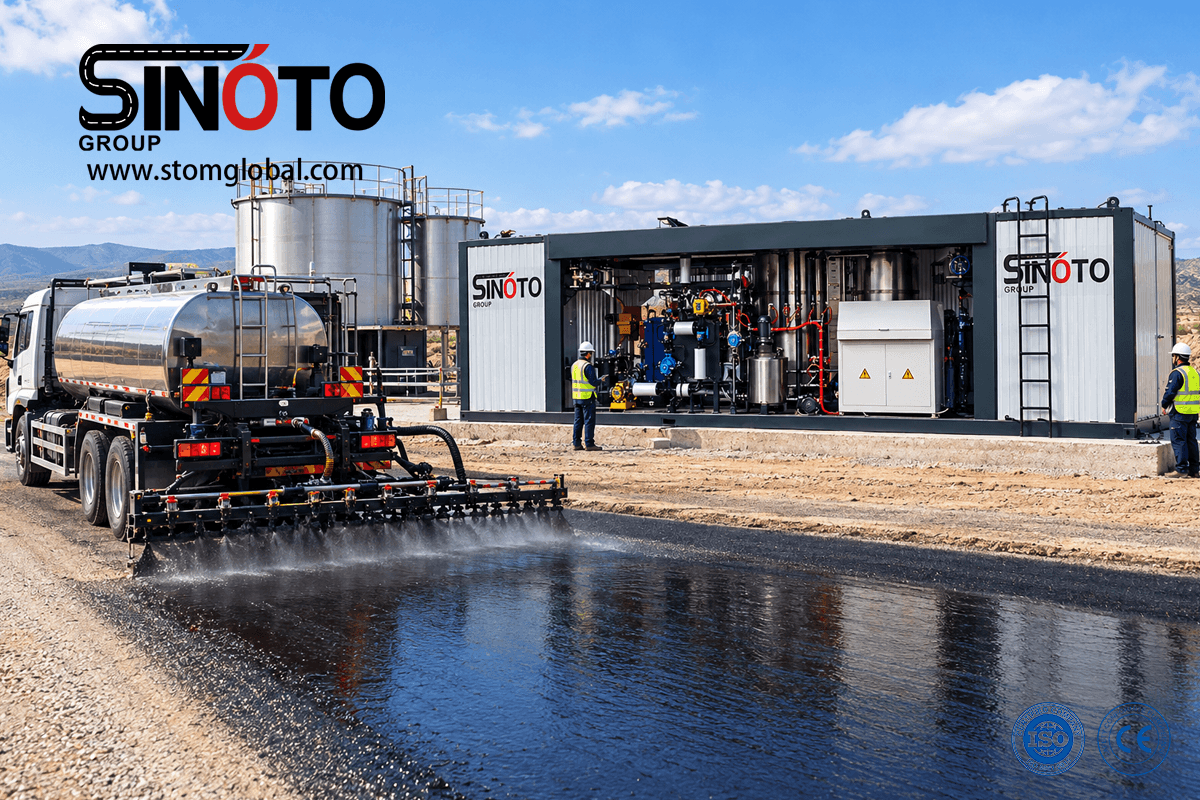
When purchasing a bitumen emulsion plant for sale, buyers should compare not only production capacity and price but also the plant’s ability to meet the required formulation.
This is especially important when polymer latex is involved.
Ask the manufacturer:
Do you support SBS or SBR?
If the answer is yes, follow up with:
What exact polymer material can the proposed plant handle?
The buyer should provide the polymer supplier’s technical data sheet whenever possible.
Not every polymer material requires the same heating arrangement.
Ask:
Does the polymer latex need heating?
What is the recommended storage temperature?
Is agitation required?
What is the maximum allowable temperature?
Is a separate heating tank included?
Is temperature monitoring included?
These questions help the manufacturer design the correct system.
Ask:
Is the polymer latex added manually or automatically?
Then ask:
What dosing accuracy is available?
For a commercial bitumen emulsion equipment manufacturer, accurate polymer addition can be an important part of the technical proposal.
The SINOTO product range uses high-precision colloid mill technology.
The standard models include:
| Model | Capacity | Colloid Mill Power |
|---|---|---|
| STEB-4 | 3–4 TPH | 11 kW |
| STEB-6 | 5–6 TPH | 22 kW |
| STEB-10 | 8–10 TPH | 37 kW |
| STEB-15 | 12–15 TPH | 45 kW |
The product page also states that the rotor-stator clearance can be adjusted down to 0.01 mm.
For modified emulsion production, the manufacturer describes heavy-duty mills and enhanced soap systems.
Ask whether the PLC controls:
Bitumen metering
Water metering
Soap solution metering
Polymer latex metering
Heating
Pump operation
Tank switching
Temperature monitoring
Alarms
Manual override
The SINOTO product page confirms Siemens PLC control technology for precise proportioning of asphalt, emulsion, and water. It also states that automatic compensation can control proportioning error within approximately 0.5%.
However, whether polymer latex dosing is integrated into that automatic control system must be confirmed for the selected configuration.
When requesting a bitumen emulsion plant price, ask for a detailed list of included and excluded equipment.
A professional quotation should clearly identify:
Standard plant
Polymer system
Heating system
Latex tank
Dosing pump
PLC cabinet
Piping
Valves
Cooling system
Installation
Commissioning
Spare parts
Shipping
This is particularly important for international buyers who may require a complete production line.
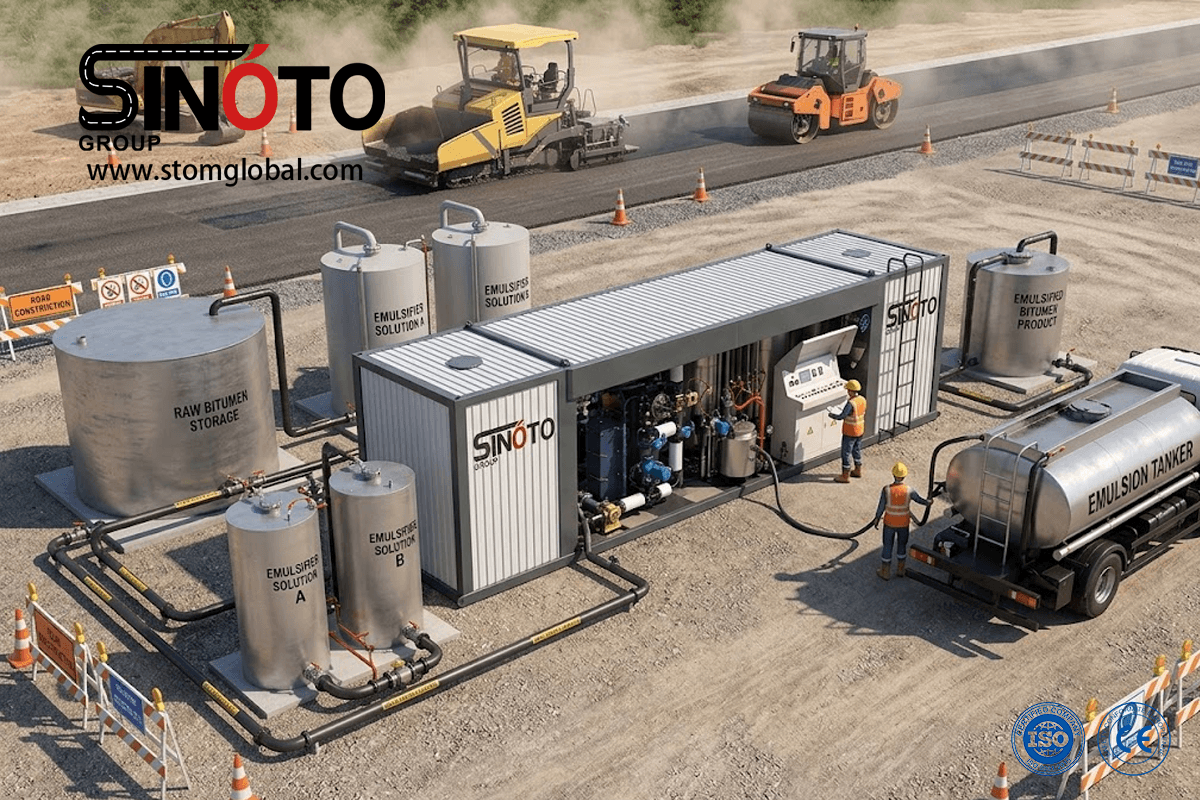
SINOTO’s product information highlights several features that can be relevant to buyers looking for a flexible asphalt emulsion plant manufacturer.
The plant uses a high-precision colloid mill with adjustable rotor-stator clearance down to approximately 0.01 mm.
This supports fine droplet formation and emulsification control.
The product page states that the plant can accommodate different emulsifiers and additives.
The emulsifier dilution system and emulsion blending/conveying system use corrosion-resistant 316 stainless steel or PPR materials, which the manufacturer describes as suitable for strong acid and strong alkali environments.
This can be relevant when the modified emulsion formulation requires specific chemical conditions.
The Siemens PLC system supports precise proportioning of asphalt, emulsion, and water.
The manufacturer states that automatic compensation can control proportioning error within approximately 0.5%.
The plant uses two emulsion tanks alternately to support continuous production.
This can be valuable for commercial producers who need consistent output for multiple road projects.
The manufacturer describes a skid-mounted modular design that can fit into standard 40-foot high-cube containers.
For overseas buyers, this can simplify transportation and installation planning.
The published standard models include 3–4 TPH, 5–6 TPH, 8–10 TPH, and 12–15 TPH.
For a buyer requiring a 10 tph bitumen emulsion plant, the STEB-10 is listed at 8–10 TPH.
For a buyer requiring a 6 tph asphalt emulsion plant, the STEB-6 is listed at 5–6 TPH.
The final capacity should be selected according to the required polymer-modified emulsion production rate.
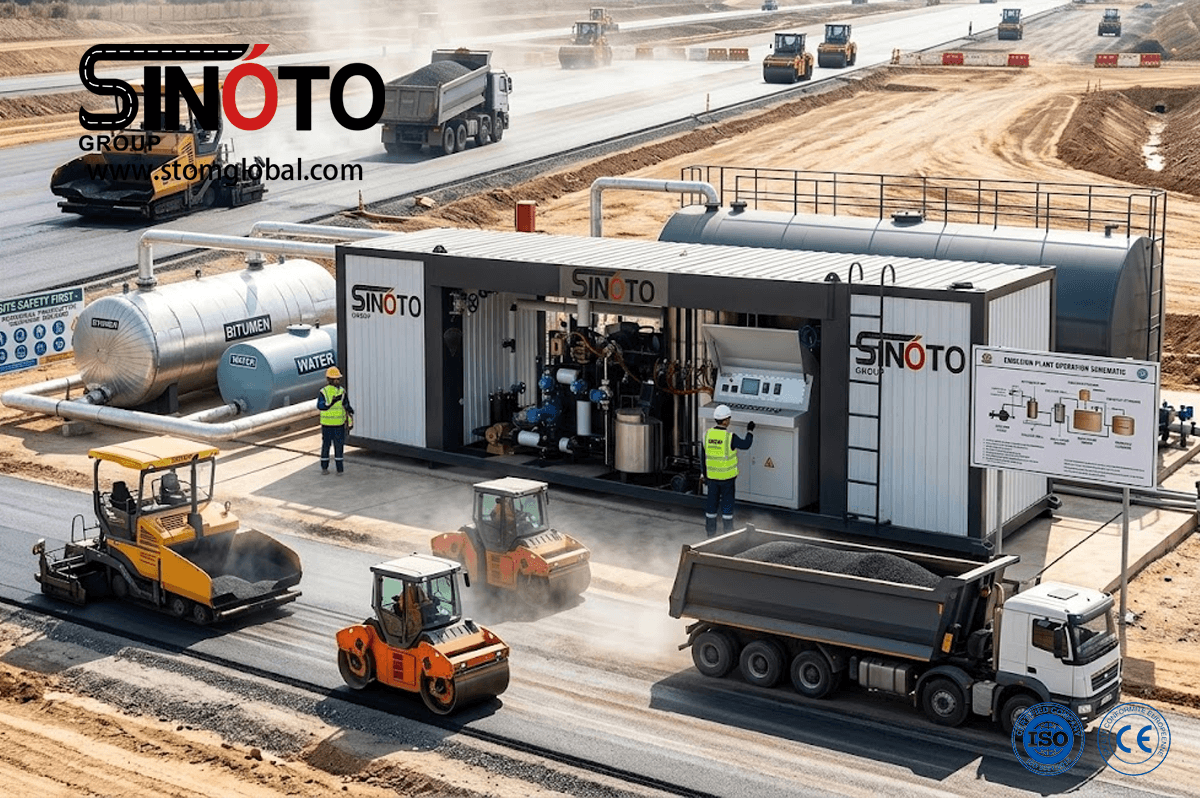
The answer can be summarized in one sentence:
The SINOTO Emulsion Bitumen Plant supports SBS and SBR modified bitumen emulsion production with heavy-duty colloid mills and enhanced soap systems, but the standard product page does not explicitly confirm a separate polymer latex heating and automatic dosing system.
For buyers, the correct next step is to specify the required polymer formulation.
| Buyer Question | Answer |
|---|---|
| Can the plant produce SBS modified emulsion? | Yes, with appropriate configuration |
| Can the plant produce SBR modified emulsion? | Yes, with appropriate configuration |
| Does it use a heavy-duty colloid mill? | Yes, for modified emulsion production |
| Does it include an enhanced soap system? | Yes, described for modified production |
| Is bitumen heating included? | Yes |
| Is soap preparation included? | Yes |
| Is emulsion cooling included? | Yes |
| Is a separate polymer latex heating tank standard? | Not explicitly confirmed |
| Is a separate polymer latex dosing pump standard? | Not explicitly confirmed |
| Is automatic SBS/SBR latex dosing available? | Must be confirmed for the selected configuration |
| Can the plant be customized? | Customized production solutions are available |
The most useful purchasing specification is therefore not simply:
“SBS/SBR modified asphalt emulsion plant.”
A more complete requirement would be:
“10 TPH asphalt emulsion plant + SBS/SBR polymer latex + target polymer content + automatic polymer dosing + heating requirements + PLC control + storage capacity.”
This gives the manufacturer enough information to prepare a more accurate technical proposal.
Are you looking for a bitumen emulsion plant for sale with SBS/SBR polymer latex capability?
SINOTO can help evaluate your required production capacity, polymer type, formulation, heating system, dosing method, colloid mill configuration, and control requirements.
To receive a project-specific proposal, provide:
Required capacity: ______ TPH
Polymer type: SBS / SBR / Other
Polymer content: ______ %
Latex form: ______
Heating requirement: ______
Required emulsion grade: ______
Automatic dosing: Yes / No
Destination country: ______
Power standard: ______
Storage capacity: ______ m³
The engineering team can then determine the appropriate plant configuration and clarify whether a dedicated polymer latex heating and dosing module should be included.
👉 REQUEST A QUOTE FOR YOUR BITUMEN EMULSION PLANT

Whatsapp ID: 8619059581045

WeChat ID: +8619059581045

