💡 Quick answer: In a well-designed polymer modified bitumen plant, solid polymer is fed by a screw feeding system and weighed, stabilizer is added through a separate dosing unit, and the base bitumen is metered on its own line. On the STOM/SINOTO STMB-10 and STMB-20, a PLC-based control system handles the coordination. The smallest model, the STMB-6, is manual-only. Buyers should confirm this before ordering.
If you are comparing polymer modified bitumen PMB production lines, the feeding system is the part most likely to decide product quality. Feed accuracy affects softening point, elastic recovery and storage stability. It also affects how much polymer you waste. This guide explains how an SBS modified bitumen plant handles solid polymer and stabilizers. It also covers whether the feed rates follow the bitumen flow, and what to ask any SBS bitumen plant manufacturer before you buy.
The technical details below come from the STMB series of PMB plant models made by HENAN SINOTO MACHINERY (STOM Global), which handles SBS, SIS, PE and EVA modifiers.
Solid polymer, usually SBS in pellet or crumb form, cannot simply be poured into hot bitumen. It has to go in at a controlled rate, be wetted evenly, and then be sheared down to fine particles. A modern SBS modified bitumen plant does this in stages:
📌 Why this matters: Fine particles only help if the dose is right. An excellent colloid mill cannot fix a plant that under-doses or over-doses polymer. Dosing accuracy comes first, and milling comes second.
| Stage | Equipment | Purpose |
|---|---|---|
| Hopper and feeding | Screw feeding system | Steady, controlled polymer intake |
| Measurement | Static weighing (modifier adding system) | Accurate polymer quantity per batch |
| Dispersion | Rapid mixing system + colloid mill | Particle size down to under 10 microns (>85%) |
| Reaction | Swelling / maturation tanks | Polymer network development |
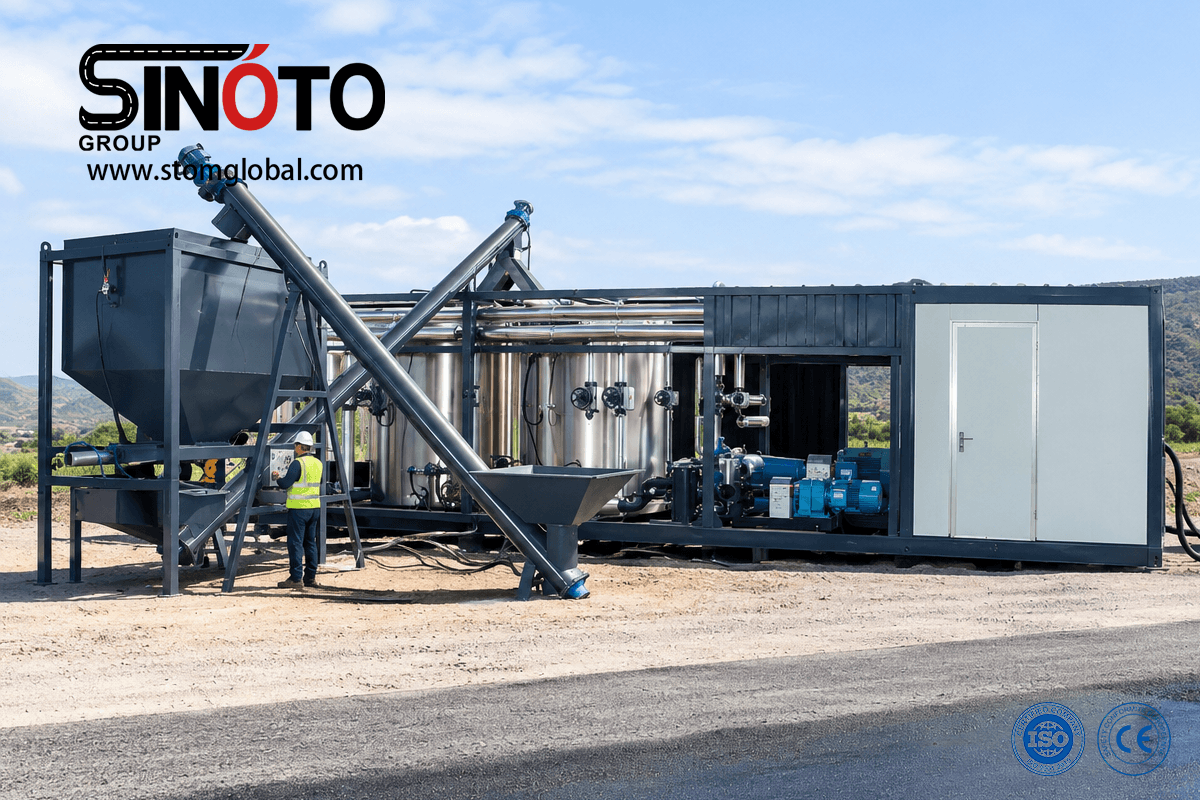
Many buyers ask about sulfur or other stabilizers because they are what keeps a PMB from separating in storage. SBS is not naturally compatible with all bitumen sources. Without a stabilizing step, polymer-rich and bitumen-rich phases can separate in a tank or tanker.
The STMB range includes a dedicated stabilizer dosing system among its main components, separate from the polymer feed. That separation is good engineering practice. A stabilizer such as sulfur is used in far smaller quantities than polymer, so it needs its own metering hardware. Otherwise small errors become large percentage errors in the recipe.
For a modified bitumen plant, good stabilizer dosing usually means:
The manufacturer says its plants are compatible with polymer brands such as Kraton, Dynasol and LG Chem, and that software presets can switch production modes, for example between high-elasticity and high-viscosity asphalt.
⚠️ Buyer tip: Ask any SBS modified bitumen plant manufacturer what the stabilizer dosing device is (pump, screw or manual addition), what its rated accuracy is, and whether it is logged in the recipe. If the supplier only says “we have a stabilizer system,” ask for details in writing.
This is the core question. The short answer is that it depends on the model and the control mode you choose. For the STOM/SINOTO range, the published information supports the following.
What the manufacturer states:
The important limitation: the technical table lists the STMB-6 as manual control, while the STMB-10 and STMB-20 offer manual or automatic control. If automatic dosing linked to flow matters to you, this affects which model you choose.
📌 What “linked” should mean: In a continuous line, the polymer and stabilizer targets are set as percentages of the bitumen throughput. If the bitumen pump speeds up or slows down, the feeders should adjust in proportion, so the final blend keeps the same ratio. This is called ratio control. Confirm with the supplier that the automatic mode actually works this way and that the polymer feeder follows the bitumen flow signal in real time.
| Question | Why it matters |
|---|---|
| Does the polymer feeder follow the bitumen pump signal automatically? | Prevents ratio drift when throughput changes |
| Is stabilizer dosing part of the same recipe? | Keeps small-quantity additives in proportion |
| What happens if an instrument fails? | The manufacturer states production can continue in manual mode |
| Can recipes be saved and recalled? | Repeatability across batches and operators |
| Is feed data recorded? | Traceability for quality audits |
The manufacturer also states that thermal oil is regulated by dual control and that a PID loop with temperature sensors and a dedicated regulating valve controls asphalt temperature. This matters for feed-rate stability, because polymer swelling depends on temperature. If the temperature swings, an accurate dose can still produce inconsistent results.
The STMB series is built around three capacities. The table below is from the manufacturer’s technical parameters:
| Parameter | STMB-6 | STMB-10 | STMB-20 |
|---|---|---|---|
| Capacity | 5–6 t/h | 8–10 t/h | 15–20 t/h |
| Colloid mill | 45 kW / 75 kW | 75 kW | 2 × 75 kW |
| SBS adding system | 2 × 2 tph | 2 × 3 tph | 2 × 4 tph |
| Control system | Manual | Manual / Automatic | Manual / Automatic |
| Thermal oil furnace | 6×10⁵ kcal | 8×10⁵ kcal | 12×10⁵ kcal |
| Total power | 65 kW | 100 kW | 200 kW |
| Total weight | 6.5 t | 10 t | 25 t |
Choosing a 10 TPH PMB plant. The STMB-10 (8–10 t/h) suits contractors and regional producers who supply their own paving jobs, or who make PMB for several nearby projects. It is the smallest model with automatic control, which makes it a common starting point for buyers who want automated dosing.
Choosing a 20 TPH polymer modified bitumen plant. The STMB-20 (15–20 t/h) suits larger producers and centralized supply. Its two 75 kW colloid mills can run in series or in parallel, and a double spiral-plate heat exchanger supports continuous production. The manufacturer says it can operate 24 hours a day.
Other design points that matter for a modified bitumen plant:
Modifier compatibility is broad: SBS, SIS, SBR, PE, EVA and rubber powder. That lets one plant serve road surfacing, and the same modified bitumen can also serve waterproofing (basements, underground works and roofs).
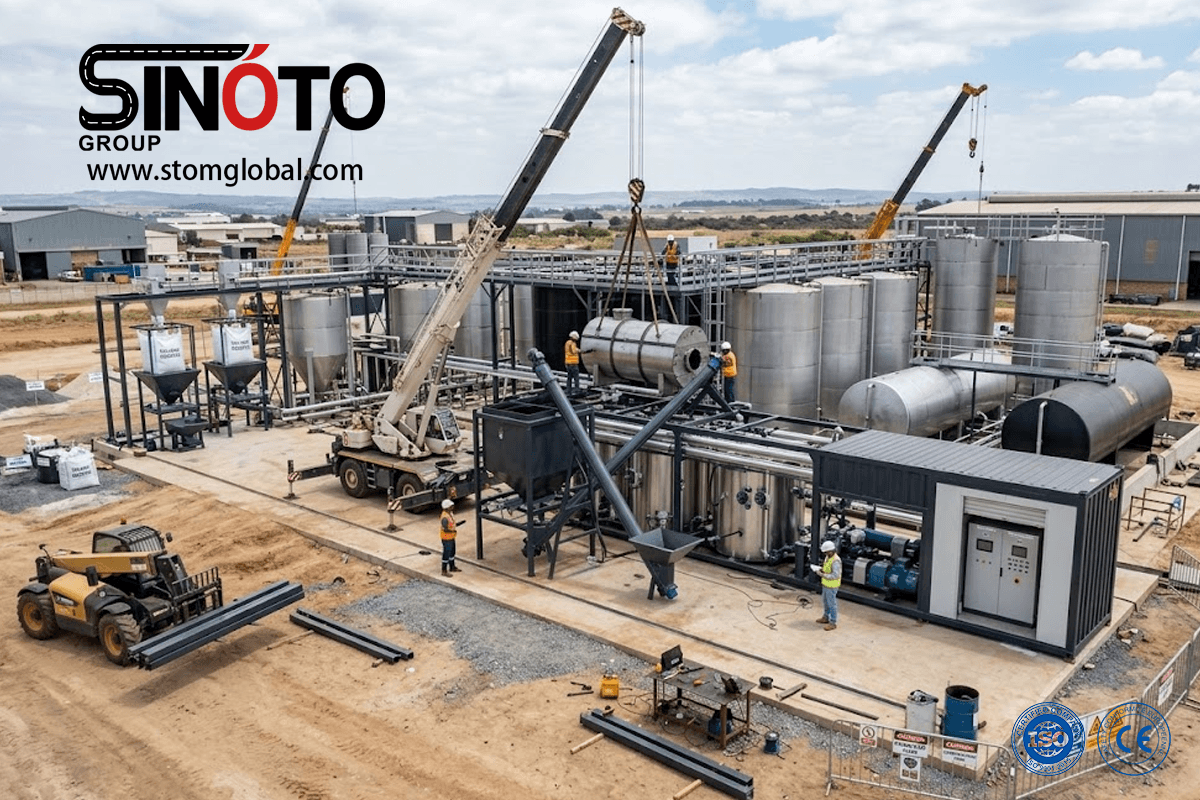
Search results for a PMB plant for sale will show a wide range of quotes. A lower headline number often leaves things out. The site does not publish prices, so ask for a written quotation. When you compare polymer modified bitumen plant price or PMB plant price offers, put them side by side on the same basis.
| Check | What to look for |
|---|---|
| ✅ Capacity | Real output at your target polymer percentage, not a peak figure |
| ✅ Fineness | Stated particle size under 10 microns for more than 85% of material |
| ✅ Dosing | Static weighing, twin feeders, separate stabilizer dosing |
| ✅ Control | Automatic mode with ratio control (not on the STMB-6) |
| ✅ Heating | Thermal oil furnace size matched to capacity |
| ✅ Components | Colloid mill and pump brands, wear-part life |
| ✅ Logistics | Container transport, installation and commissioning support |
| ✅ After-sales | Spare parts, remote support, operator training |
Factors that move the price of an SBS bitumen plant:
A reliable SBS modified bitumen plant manufacturer should be able to explain each of these in plain terms and show reference installations. Ask for project cases and, if possible, a factory visit or a video of a live run.
💬 Final thought: A cheap PMB plant with weak dosing costs more over time, through wasted polymer, rejected batches and unstable storage. Accurate feeding is the difference between a plant that produces consistent polymer modified bitumen and one that needs constant operator correction.
Whether you need a 10 TPH PMB plant or a 20 TPH polymer modified bitumen plant, the STOM/SINOTO engineering team can review your capacity target, polymer type and dosing requirements, and quote a configuration to match.
📧 info@stomglobal.com | 📱 WhatsApp: +86 190 5958 1045
#PolymerModifiedBitumen #PMBPlant #SBSModifiedBitumen #BitumenPlant #RoadConstruction #AsphaltMachinery

Whatsapp ID: 8619059581045

WeChat ID: +8619059581045

