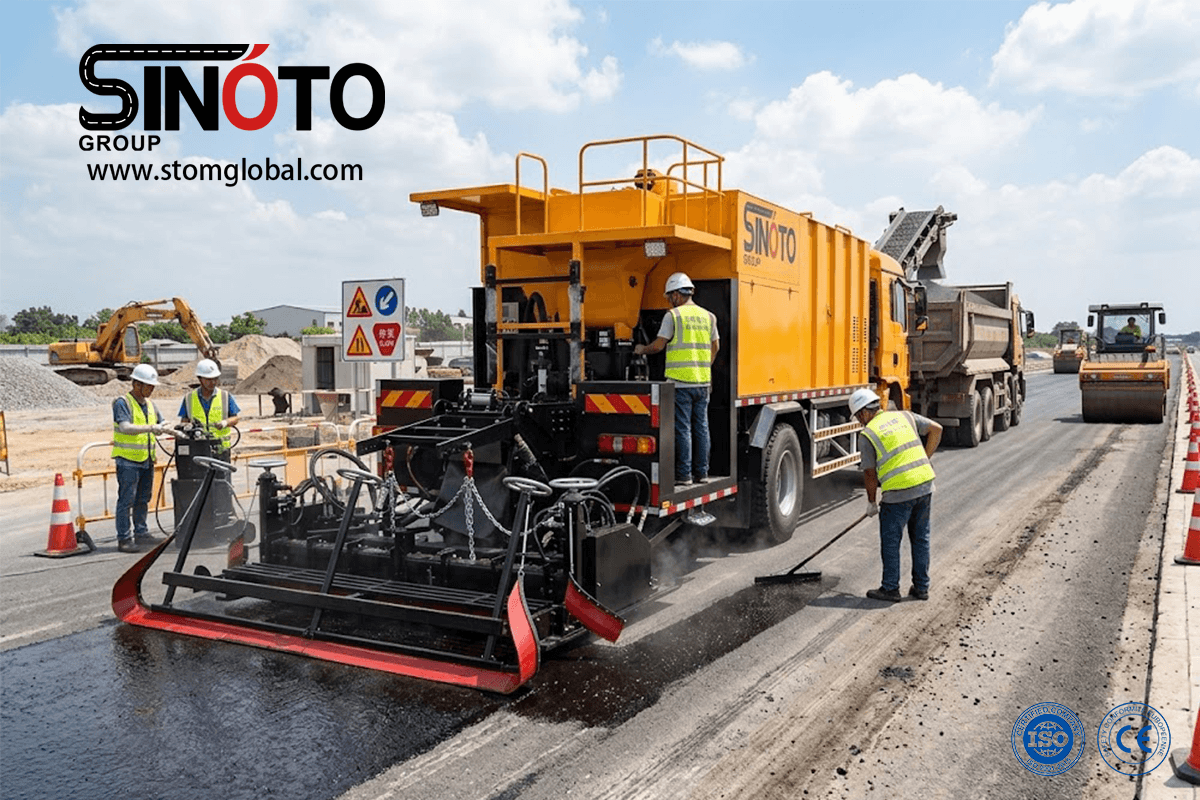
Achieving a consistent asphalt-aggregate ratio is the single most important factor separating a professional-grade slurry seal machine from a rough, unreliable one. Too much emulsion and the slurry becomes sticky, slow to break, and prone to bleeding; too little and the mat turns dry, crumbly, and fails to bond aggregate particles together. On a modern micro surfacing paver, this ratio is no longer left to a human operator turning valves by feel — it is measured, calculated, and corrected automatically, dozens of times per minute, by an integrated electronic control system.
This article breaks down exactly how that automated proportioning works, what hardware makes it possible, and why it matters for anyone specifying a micro surfacing machine for highway, airport, or municipal road maintenance work.
ℹ️ Quick definition: Slurry seal is a thin surface treatment made by blending graded aggregate, emulsified asphalt, filler (cement, lime, or mineral powder), additives, and water into a homogeneous slurry, then spreading it evenly across the pavement. Because the mix must set predictably within minutes of leaving the mixer, ratio accuracy cannot depend on guesswork.
At the heart of every modern micro surfacing paver is a closed-loop feedback system that continuously compares two numbers: how much aggregate is actually flowing into the mixer, and how much emulsified asphalt is being metered in alongside it. Instead of running the pumps and feeders at a fixed, pre-set speed, the control unit reads live sensor data and recalculates the correct binder output several times per second.
The basic logic works like this:
💡 Info: This is why the feature is often marketed as “Automatic Asphalt-Aggregate Ratio Control” — the emphasis is on automatic, meaning the correction happens without the operator manually adjusting a single valve, even as driving speed changes constantly during real-world paving.
The practical benefit is a slurry mat with a uniform texture from the start of a run to the end, with no visible banding, no soft spots, and no wasted material from over-application.

Ratio control only matters if the mixed slurry is actually homogeneous by the time it reaches the spreader box. A slurry seal machine has to solve two problems simultaneously: metering the right proportions, and blending them thoroughly before the mix begins to break (set).
This is handled through several coordinated subsystems:
| Control Function | Component | Role in Ratio Accuracy |
|---|---|---|
| Binder metering | Variable displacement bitumen pump | Adjusts emulsion output to match aggregate flow in real time |
| Speed synchronization | Hydraulic variable pump & proportional valve set | Links mixer, feeder, and pump speeds so ratios stay locked together |
| Data processing | Electronic control system & text display | Reads sensor input and recalculates ratios continuously |
| Mixing uniformity | Improved pugmill / mixer design | Prevents dead zones so the metered ratio translates into a truly homogeneous slurry |
| Output adjustment | Adjustable spreading box | Maintains consistent thickness even as ratio and volume fluctuate |
🔎 As one long-time paving contractor put it during a field demonstration: consistent ratio control matters less on a straight highway stretch and far more in stop-and-go intersection work, where speed changes constantly and any lag in the control system shows up immediately as streaking on the finished surface.
Because the feeder, mixer, and pump all respond to the same live data stream, a well-engineered slurry seal paver keeps the mix stable whether the truck is crawling at 1.5 km/h through a tight urban intersection or moving faster along an open rural road.
Ratio accuracy is not a cosmetic feature — it directly affects pavement performance, project cost, and compliance with specification. Three consequences make this especially important for buyers evaluating slurry seal equipment:
1. Surface durability and skid resistance. An under-bound mix ravels and loses aggregate under traffic; an over-rich mix can bleed asphalt to the surface in hot weather, reducing friction. Automated ratio control keeps both risks in check across an entire project, not just at the point where a technician last checked the mix.
2. Material cost control. Emulsified asphalt is typically the most expensive input in a slurry mix. A feeder that runs slightly rich “just to be safe” wastes binder over the length of a project. Precise, automatic proportioning means the machine only uses what the mix design calls for — no more, no less.
3. Compliance with mix design specifications. Most agency specifications define an acceptable ratio tolerance (often within ±0.5% of target emulsion content). A machine that adjusts output only when the operator manually intervenes cannot reliably hold that tolerance across an entire day’s paving, especially with frequent stops and speed changes. Continuous automated correction is what makes tight tolerances achievable in practice.
ℹ️ Info tip: When comparing an asphalt slurry machine on paper, ask the supplier specifically how the ratio system responds to speed changes — a system that only recalculates at fixed intervals is fundamentally different from one that continuously feeds back sensor data in real time.
The proportioning intelligence of a microsurfacing paver depends on a chain of hardware and software components working together. On a well-built unit, these typically include:
| System Layer | Function |
|---|---|
| Sensing | Detects aggregate feed rate and travel speed |
| Processing | Calculates the correct binder output for the current feed rate |
| Actuation | Adjusts pump and feeder speeds via hydraulic valves |
| Feedback | Confirms actual output matches the target, closing the loop |
| Display | Gives the operator visibility and manual override if needed |
This layered design is what allows a single micro paver unit to be reprogrammed for different mix designs — a fiber-reinforced micro-surfacing mix, a standard slurry seal mix, or a lower seal coat — simply by adjusting target ratios in the control software, rather than retrofitting mechanical components.
Zooming out from the ratio-control mechanism itself, it’s worth understanding why this level of automation has become standard across serious road maintenance vehicle fleets rather than a premium add-on.
Road agencies increasingly specify quality-control documentation — ratio logs, throughput records, and thickness measurements — as part of contract acceptance. A machine that automatically tracks and adjusts its own asphalt-aggregate ratio makes this documentation straightforward, since the same sensors used for control can also generate a data trail for quality assurance.
There is also a labor and consistency argument. Manual ratio adjustment depends on an experienced operator constantly monitoring gauges and making judgment calls — accuracy varies operator to operator, and even a skilled operator cannot react as fast as an electronic feedback loop. Automating the process:
💡 Info: Look for a micro surfacing machine that pairs automatic ratio control with a one-button start-stop function — this combination minimizes both material waste during startup/shutdown transitions and the chance of operator error during routine operation.
For contractors managing multiple pieces of asphalt slurry seal equipment across a fleet, standardizing on machines with reliable automated proportioning also simplifies maintenance planning and operator cross-training, since the control logic and interface stay consistent from one unit to the next.
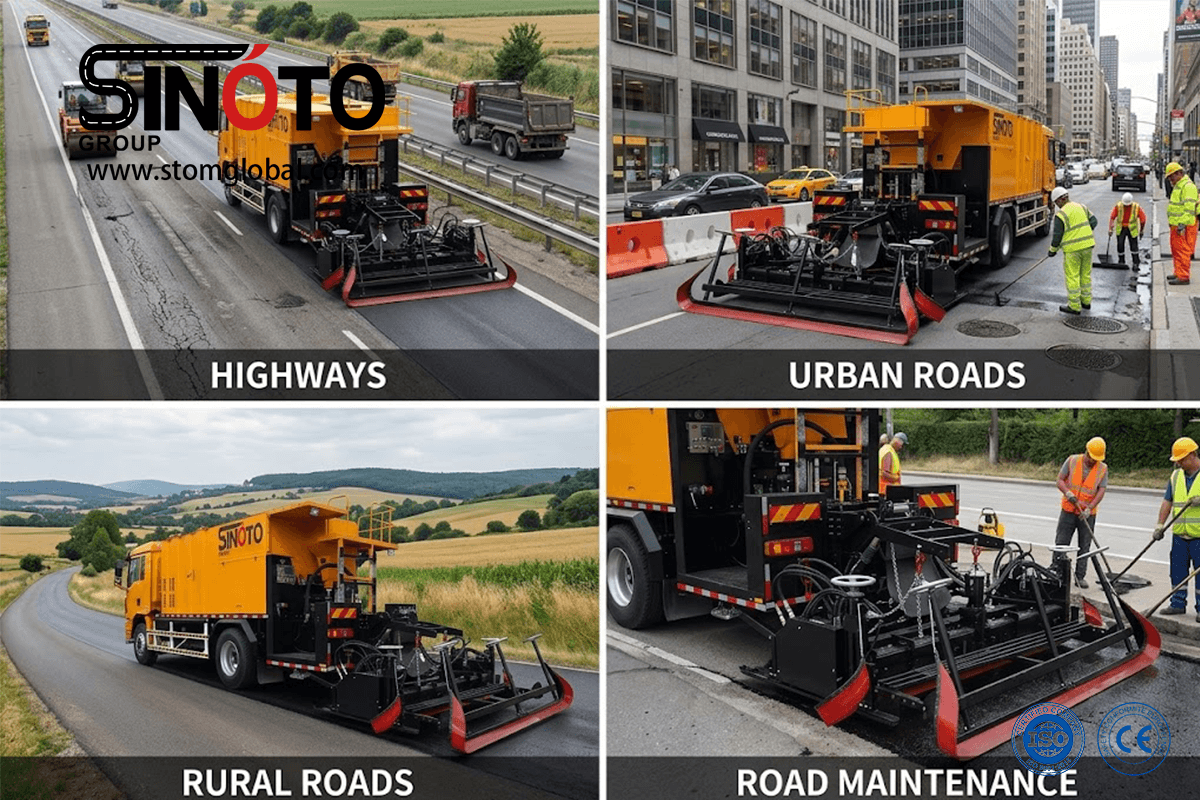
Modern slurry seal machine and micro surfacing paver designs solve the asphalt-aggregate ratio challenge through a closed-loop system: sensors measure real-time aggregate flow, a control unit calculates the correct binder output, and hydraulic actuators adjust pump and feeder speeds instantly — all without operator intervention, even as travel speed and paving conditions change. This automated approach protects pavement performance, controls material cost, and helps contractors meet the tight ratio tolerances demanded by modern road maintenance specifications.
If you are evaluating a slurry seal paver, microsurfacing paver, or any other road maintenance vehicle for an upcoming project, understanding how its ratio-control system actually works — not just its headline specifications — is one of the most important due-diligence steps you can take.
👉 Click here to Request a Free Quote & Technical Consultation

Whatsapp ID: 8619059581045

WeChat ID: +8619059581045