Road owners and paving contractors are under constant pressure to extend pavement life while keeping budgets in check. That’s why slurry road surfacing and micro-surfacing technologies have become the go-to choice for cost-effective pavement preservation. But one question keeps coming up from engineers evaluating new equipment: can a modern slurry sealing paver actually process fiber-reinforced micro-surfacing mixes, or is that job reserved for specialized, high-cost machinery?
The short answer is yes — but only if the machine is built with the right mixing system, fiber-feeding components, and control technology. This article breaks down exactly how a properly engineered slurry seal machine manages fiber reinforcement, what specifications matter, and how to evaluate a slurry seal machine for sale if fiber-reinforced work is part of your project pipeline.
💬 “Fiber-reinforced micro-surfacing isn’t just slurry with fiber thrown in — it requires a dedicated fiber tank, precise dosing, and a mixer engineered to disperse fiber evenly without clumping.” — Road maintenance equipment engineering perspective
Before answering whether equipment can handle it, it helps to understand what fiber-reinforced micro-surfacing actually is within the broader category of slurry coat asphalt treatments.
Slurry sealing is a cold-applied surface treatment made by blending graded aggregate, emulsified asphalt binder, filler (cement, lime, fly ash, or mineral powder), additives, and water into a homogenous slurry. This mixture is then spread across the pavement in a thin, uniform layer to restore skid resistance, waterproof the surface, and correct minor cracking or raveling.
Fiber-reinforced micro-surfacing takes this a step further. Short glass fibers (or similar reinforcing fibers) are introduced into the slurry mix to:
Because fiber changes the rheology of the mix, not every slurry machine on the market is equipped to handle it. A standard mixer without a dedicated fiber-feeding line can struggle with clumping, uneven dispersion, or blocked discharge — which is exactly why fiber capability has become a key differentiator in the slurry surfacing equipment category.
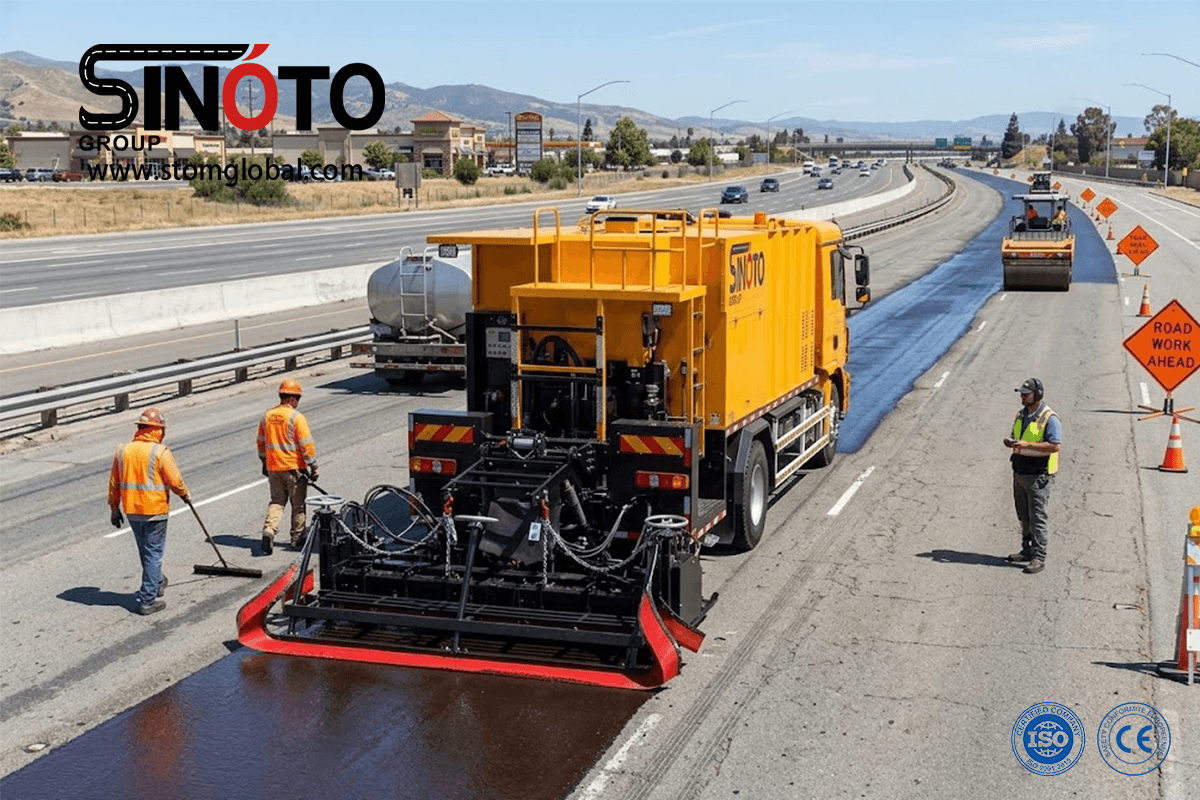
This is the core of the question. A slurry seal machine capable of fiber-reinforced work needs several purpose-built systems working together, not just a bigger hopper.
Machines designed for fiber-reinforced micro-surfacing include a separate fiber tank — often holding several coils of glass fiber — with a metered feed line into the mixing chamber. This ensures fiber enters the mix at a controlled, consistent rate rather than being dumped in bulk, which would cause tangling.
Fiber dispersion depends heavily on mixer geometry. A high-torque, wear-resistant pugmill-style mixer with continuous rotation prevents fiber from balling up and ensures the aggregate, emulsion, filler, additive, and fiber blend uniformly before discharge.
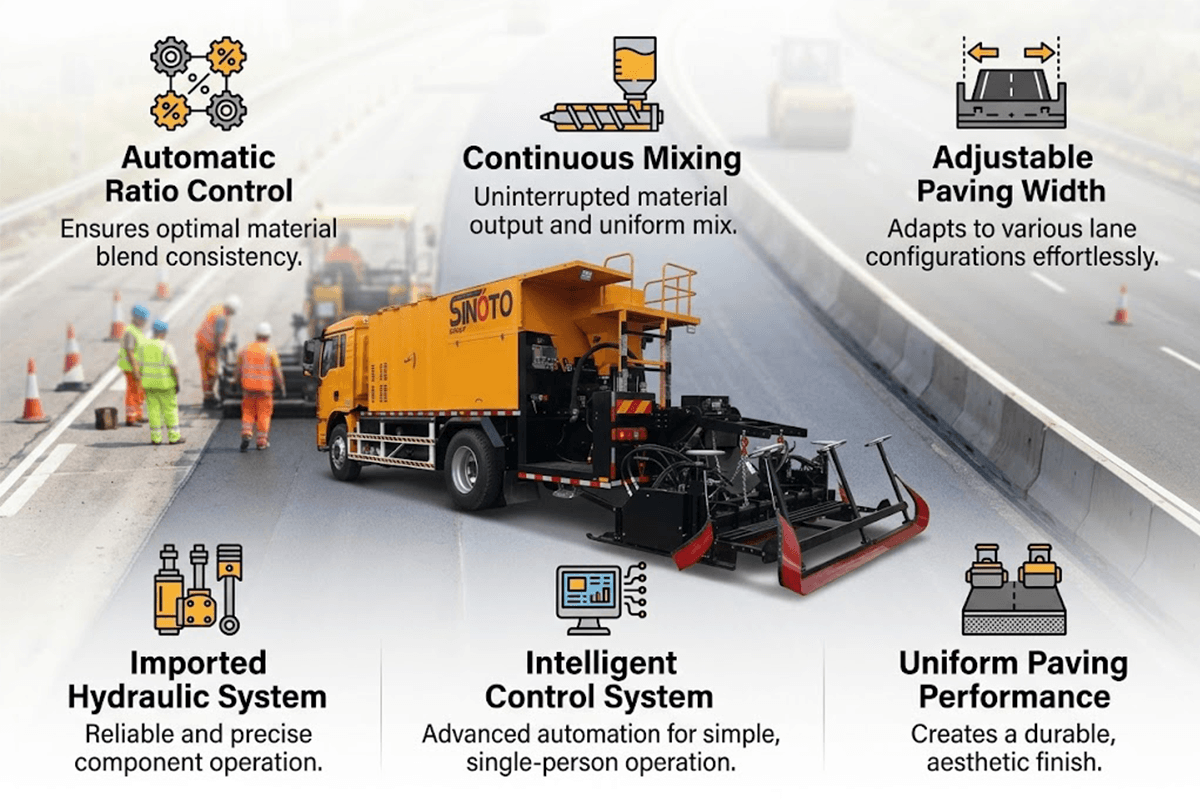
Because fiber addition can affect flow characteristics, the road sealing machine needs an automated proportioning system that adjusts material output relative to paving speed. This keeps the asphalt-to-aggregate ratio — and now the fiber ratio — consistent even as the truck speeds up or slows down, minimizing visible seams and inconsistent texture.
A real-time feedback control system (often using components like variable hydraulic pumps and proportional directional valves) continuously monitors material consumption and adjusts flow automatically, regardless of driving speed. This is what allows a single operator to run fiber-reinforced batches with a one-button start-stop function instead of manually recalibrating for every section of road.
| ✅ Fiber-Ready Feature | Why It Matters for Fiber-Reinforced Micro-Surfacing |
|---|---|
| Dedicated fiber tank/coils | Controlled, consistent fiber dosing into the mix |
| No-dead-zone mixing chamber | Prevents fiber clumping and ensures even dispersion |
| Automatic ratio control | Maintains consistent asphalt-aggregate-fiber ratio at variable speeds |
| Adjustable paving box | Delivers uniform thickness even with fiber-modified slurry |
| Wear-resistant components | Withstands the added abrasiveness of fiber-reinforced mixes |
Not every model in a manufacturer’s lineup will include fiber capability by default — it typically appears on mid-to-large-capacity machines designed for higher-output surface treatment programs. Below is a representative specification comparison across common configuration tiers of a truck-mounted slurry sealing paver line.
| Item | Smaller Unit | Mid-Size Unit | Large Fiber-Capable Unit |
|---|---|---|---|
| Chassis Type | 4×2 | 4×2 | 6×4 / 8×4 |
| Aggregate Hopper Capacity | 3 m³ | 6 m³ | 10–13 m³ |
| Emulsion Tank Volume | 1.2 m³ | 1.2 m³ | 3.5–4 m³ |
| Water Tank Volume | 1.2 m³ | 1.2 m³ | 3.5–4 m³ |
| Fiber Tank | Not equipped | Not equipped | 8 coils of glass fiber |
| Additive Tank Volume | — | — | 400 L |
| Mixer Discharging Capacity | Up to 2.5 T/min | Up to 2.5 T/min | Up to 3.5 T/min |
| Paving Thickness | 3–15 mm | 3–15 mm | 3–15 mm |
| Paving Width (Adjustable) | 1600–2500 mm | 1600–2500/2500–4300 mm | 2500–4300 mm |
As the table shows, fiber-reinforced capability generally comes paired with larger hopper volumes, higher emulsion and water tank capacity, and a dedicated additive tank — because fiber-reinforced mixes require more precise, higher-volume material management than a standard prime coat or basic micro-surfacing job.
💡 Tip: If fiber-reinforced micro-surfacing is a recurring part of your road maintenance program, prioritize models that list a fiber tank and additive tank as standard configuration items — retrofitting fiber capability onto a base machine is rarely cost-effective.
When you’re comparing a slurry seal machine for sale, fiber capability is just one factor. Here’s a practical checklist for evaluating whether a machine fits a broader pavement preservation and asphalt road repair program:
Many agencies and contractors don’t run fiber-reinforced jobs exclusively — they need a road sealing machine that flexes between prime coats, standard slurry seal, and fiber-reinforced micro-surfacing depending on the project. This versatility is one of the main reasons fiber-capable machines are increasingly specified even for programs where fiber use is occasional rather than constant — it future-proofs the equipment investment.
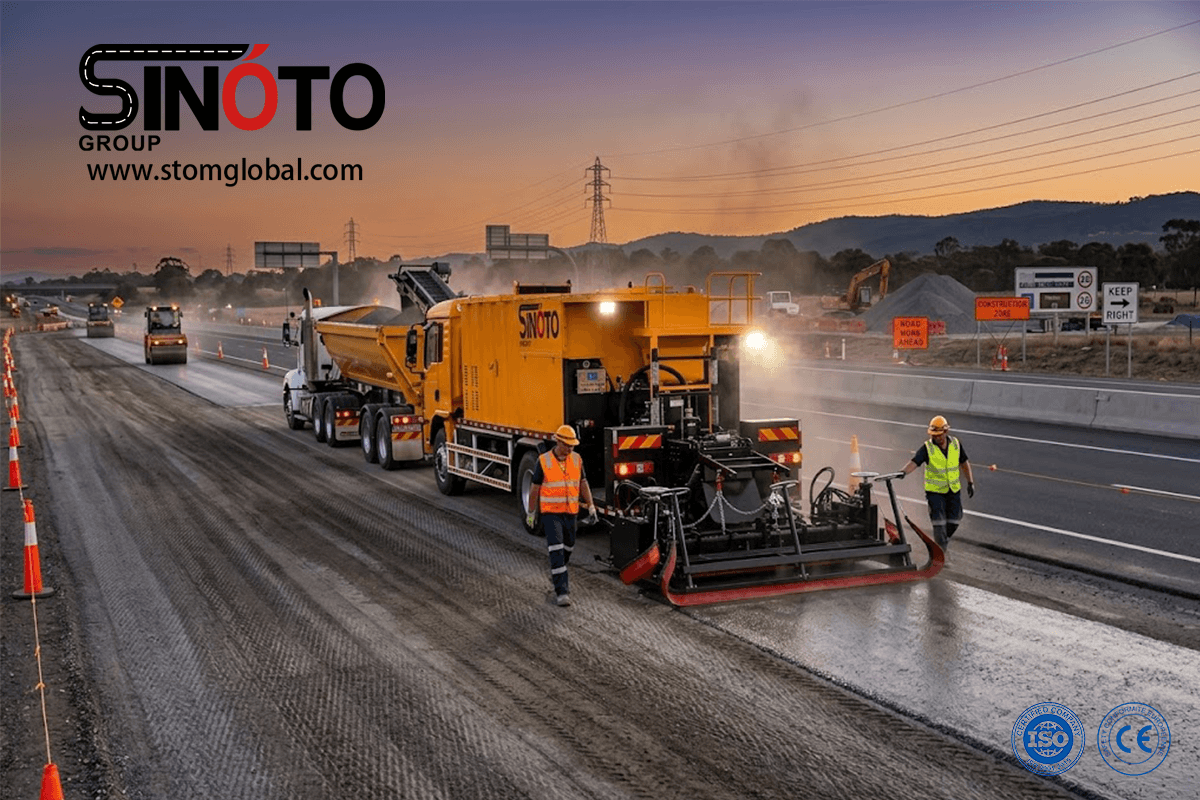
Cost is naturally a major factor, and micro surfacing machine price varies significantly based on chassis size, hopper capacity, and whether fiber and additive systems are included.
⚠️ It’s worth noting that a lower upfront price on a non-fiber-capable machine can translate into higher long-term costs if your agency later needs fiber-reinforced treatments and has to either subcontract that work or invest in a second machine.
When evaluating micro surfacing machine price against total value, factor in:
For agencies managing a large road maintenance network, a fiber-capable slurry seal machine typically pays for itself through reduced reflective cracking, fewer repeat treatments, and the ability to bid on a wider range of surface treatment contracts — including specifications that explicitly call for fiber-reinforced micro-surfacing.
So, can a slurry sealing paver handle fiber-reinforced micro-surfacing? With the right configuration — a dedicated fiber tank, no-dead-zone mixing system, automatic ratio control, and adequately sized emulsion and water tanks — the answer is a confident yes. The key is matching the specific model to your application needs before purchase, since fiber capability is a design feature, not an afterthought that can be bolted onto any basic slurry surfacing equipment.
Whether your program focuses on prime coats, standard slurry road surfacing, or advanced fiber-reinforced treatments, choosing equipment engineered for all three keeps your asphalt road repair and pavement preservation operations flexible, efficient, and ready for whatever specification comes next.
Have questions about fiber tank configuration, hopper sizing, or getting an updated slurry seal paver price for your program?

Whatsapp ID: 8619059581045

WeChat ID: +8619059581045

