Road contractors are moving away from drums and tankers and buying bitumen in one-ton flexible bags. Bags are cheaper to ship, easier to stack and safer to store. The question is how fast you can turn them into pumpable liquid on site. Before you sign a purchase order, you need to know how much bitumen a jumbo bag bitumen melter can process per hour.
The short answer is 5 to 12 tons per hour, depending on the model. The number that matters, though, is the one you can sustain across a full shift. This guide is based on the specifications of the SINOTO STBD series. It covers what drives real throughput, what buyers should check, and how to size a jumbo bag bitumen melting machine for your project.
📌 Quick Answer: The STBD-6 processes 5–6 tons per hour, and the STBD-10 processes 10–12 tons per hour. That is roughly 5–12 one-ton bags every hour.
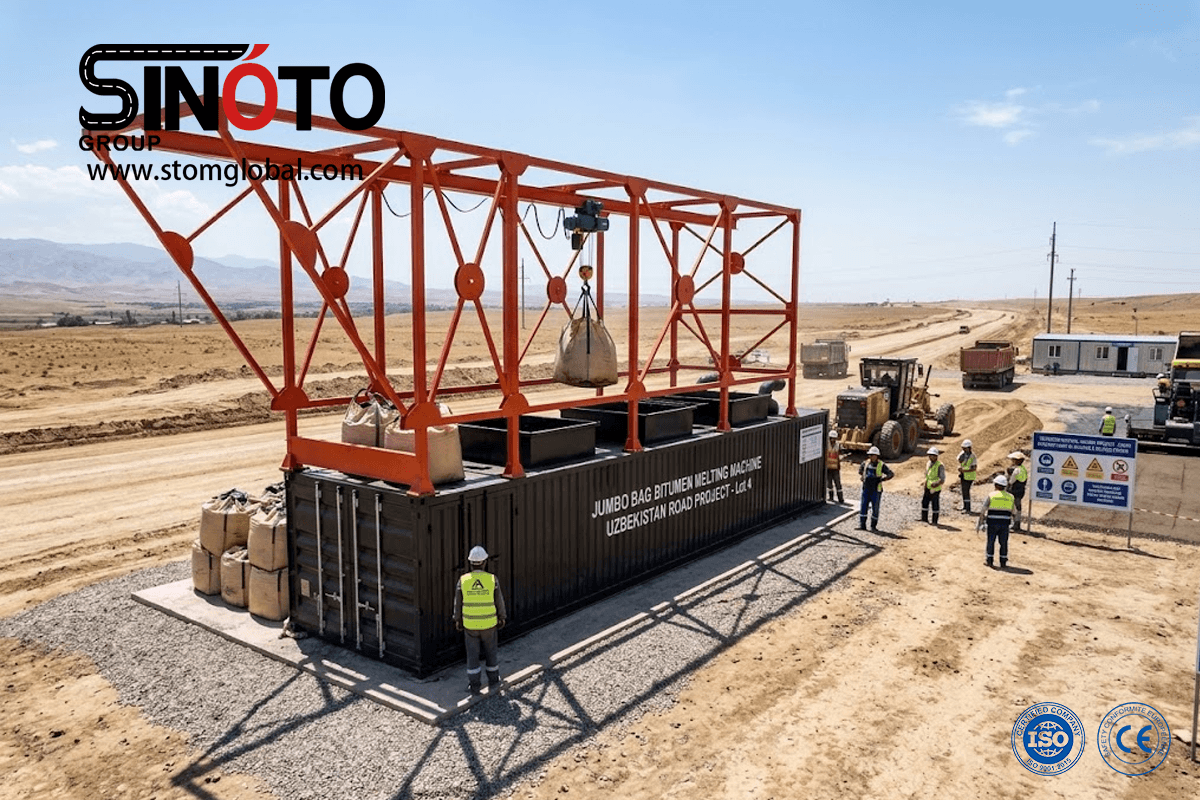
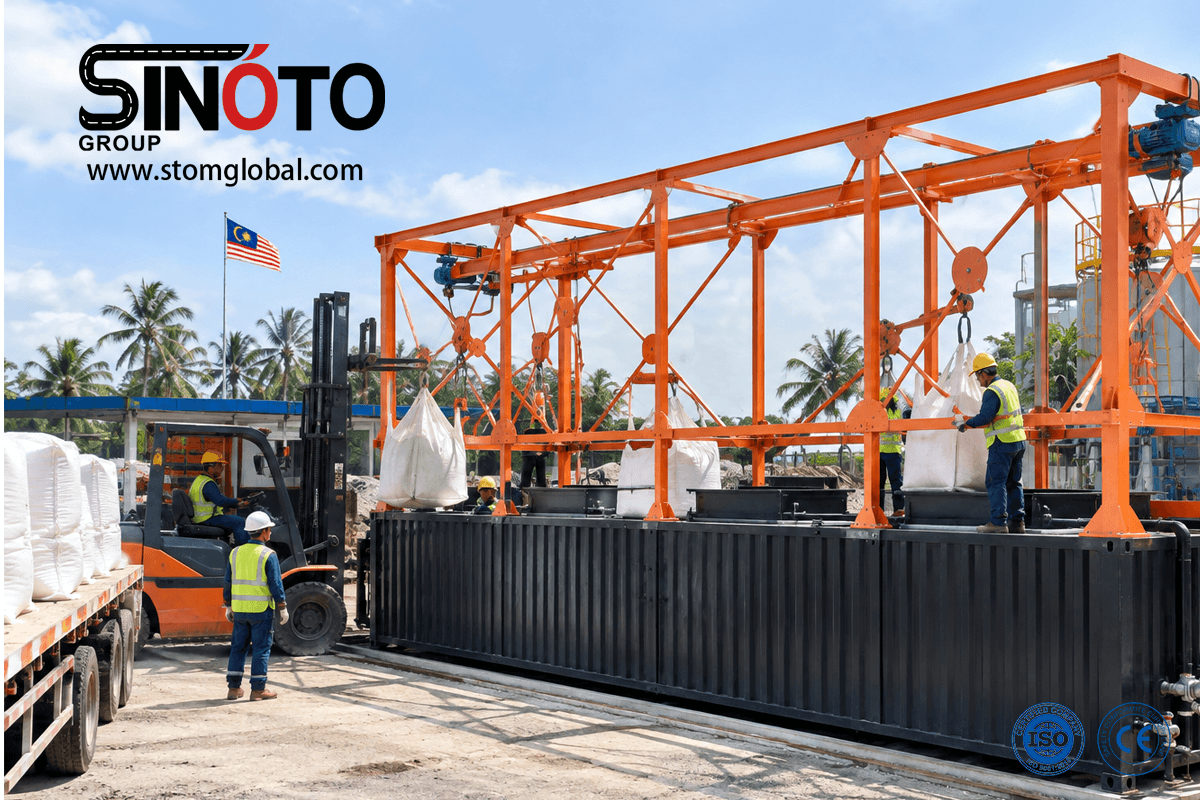
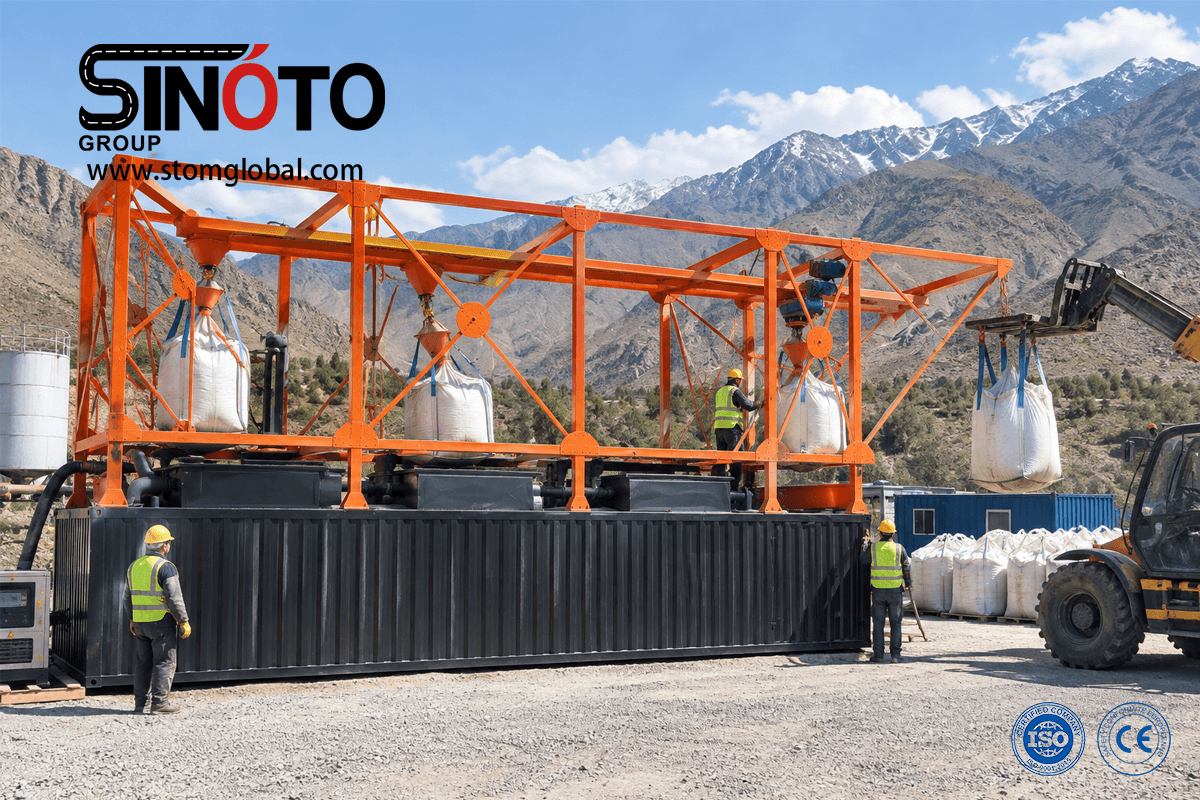
A jumbo bag bitumen melter (also called a bitumen decanter) heats solid bitumen in bulk bags until it turns liquid. It then pumps the liquid to a storage tank or straight to your asphalt plant. It has two main parts. The first is a skid-mounted melting chamber with 3–5 feeding ports and a heating bin. The second is a bolt-together hoisting structure with a 2-ton electric hoist.
Each feeding port is a parallel melting position. More ports mean more bags melting at once, so the number of feeding mouths is a large part of a machine’s capacity.
| Parameter | STBD-6 | STBD-10 |
|---|---|---|
| Productive capacity | 5–6 t/h | 10–12 t/h |
| Feeding mouths | 3 | 5 |
| Max. hoisting capacity | 2,000 kg | 2,000 kg (two hoists) |
| Max. hoisting height | 3 m | 3 m |
| Melting pool capacity | 32 m³ | 80 m³ (35 + 45) |
| Bitumen pump capacity | 16.8 m³/h | 24 m³/h |
| Heating method | Oil burner or thermal oil furnace | Oil burner or thermal oil furnace |
| Total power | 15 kW | approx. 20–22 kW |
| Total weight | 12,000 kg | 20,000 kg |
| Transport size (L×W×H) | 11,500×2,250×2,450 mm | 11,500×2,250×2,450 mm (2 units) |
Because a standard bag holds one ton, the arithmetic is simple:
These are theoretical figures. Actual output depends on the bitumen grade, the ambient temperature, the target discharge temperature and how quickly your crew loads bags.
The pump rating gives a second check. The STBD-6 pump moves 16.8 m³/h and the STBD-10 pump moves 24 m³/h. Both are well above melting throughput, so the pump will not hold back the flow.
Capacity is only one line on a buyer’s checklist. Procurement managers, EPC contractors and distributors usually raise six other concerns before they request a quote for a bulk bitumen melting machine.
Open-flame melting is a fire risk. The SINOTO design heats the bitumen indirectly through thermal oil pipes, so there is no direct flame contact. Automatic temperature and pressure control and a high-temperature alarm add further protection. Enclosed operation also limits worker exposure to hot bitumen and fumes.
Buyers want to use the energy source that is cheap where they work. This bitumen melting machine can connect to an external thermal oil system, use a built-in diesel or gas burner, or, on request, use an electric heating solution.
Road projects move, and so should the equipment. The melting chamber is skid-mounted and sized for standard container shipping. The tall hoisting frame is bolted together and comes apart for transport.
Bitumen left in a bag is money thrown away. The suspension system and residue-free discharge are designed to recover the bitumen from each bag.
A 1-ton bag cannot be lifted by hand. The integrated hoist handles loading, so you do not need a separate crane on site.
Buyers compare the machine price against fuel consumption, labor and material savings. We come back to that in the pricing section below.
💡 Buyer Tip: Ask any supplier for capacity figures per model and per feeding-mouth count. A machine with fewer ports cannot reach a high hourly rate, whatever the brochure says.
Two machines can both list 10 t/h and perform very differently on site. The gap comes from heat transfer, insulation and how the tanks are arranged. A good bulk bag asphalt melter does the following.
Finned-tube heat exchange. The heat exchange area is 1.5 times that of conventional thermal oil pipes, so heat reaches the bitumen faster.
Dual heat recovery. A thermal oil system is combined with flue gas and fume recovery, and hot air is circulated. This lowers heat loss and fuel use and keeps the heating uniform.
Multi-circuit coils. The oil coils are split into several circuits. Heat can be balanced and directed to where it is needed, which speeds up melting.
Full insulation. High-density rock wool on all sides keeps heat in the chamber. It shortens warm-up and cuts energy waste.
Independent main and auxiliary tanks. The main tank melts while the auxiliary tank works as separate storage. Melting and temperature raising can go on at the same time without interference, which raises output.
Automatic temperature control. Ignition follows the temperature reading. That prevents local overheating, aging and carbonization, so the bitumen keeps its original specifications.
PLC control. Centralized or PLC control allows one-touch start-up, so operators need little training.
“Melting fast is easy. Melting fast without damaging the bitumen is what separates a good machine from a cheap one.”
| Advantage | Buyer Benefit |
|---|---|
| Indirect thermal oil heating | Lower fire and explosion risk |
| Finned tubes (1.5× area) | Faster melting, lower fuel bill |
| Rock wool insulation | Less heat loss, shorter heat-up |
| Split main/auxiliary tanks | Continuous melting and storage |
| Auto temperature control | Bitumen quality protected |
| Skid-mounted, bolted hoist | Easy transport and relocation |
Almost every buyer asks about jumbo bag bitumen melter price early on. No honest supplier can give one fixed number, because the bitumen bag melter price depends on your configuration. These are the main factors:
The purchase price should be weighed against operating savings. Bulk bags usually cost less to freight and handle than drums. Where a plant runs continuously, higher thermal efficiency and lower waste can pay back a larger machine quickly.
💬 Pricing Note: To get an accurate jumbo bag bitumen melting machine for sale quote, send your daily bitumen demand, site voltage, fuel type and destination port.
A melter is one link in a larger chain. Good bulk bitumen handling starts with how bitumen arrives on site and ends with how it is stored, heated and delivered to the mixer. A 1 ton bag bitumen melter covers the middle of that chain.
Melted bitumen needs somewhere to go. The pool volumes (32 m³ and 80 m³) give buffer capacity. Many operators also link the melter to a separate heated tank. Sizing the storage well means your paving or mixing crew never waits for material, even if bag loading pauses briefly.
Good planning keeps the whole line, from bag to plant, moving at the rated 5–12 tons per hour.
To answer the original question: a Jumbo Bag Bitumen Melting Machine from SINOTO processes 5–6 tons per hour with the STBD-6 and 10–12 tons per hour with the STBD-10. Capacity comes from the number of feeding mouths, the heat-transfer design, the insulation and the tank layout. The safety features, fuel options and portability make it a practical choice for modern road construction.
If you are comparing suppliers, ask for a model matched to your daily tonnage and your local conditions. The cheapest jumbo bag bitumen melter is not always the most economical over its service life.
Tell us your project size, fuel type and destination. Our engineers will recommend a model and send a tailored quote.
📩 Request a Quote / Send Your Inquiry Now
📧 info@stomglobal.com | 📱 WhatsApp: +86 190 5958 1045
#JumboBagBitumenMelter #BitumenMeltingMachine #BulkBitumenHandling #BitumenStorage #RoadConstruction

Whatsapp ID: 8619059581045

WeChat ID: +8619059581045

